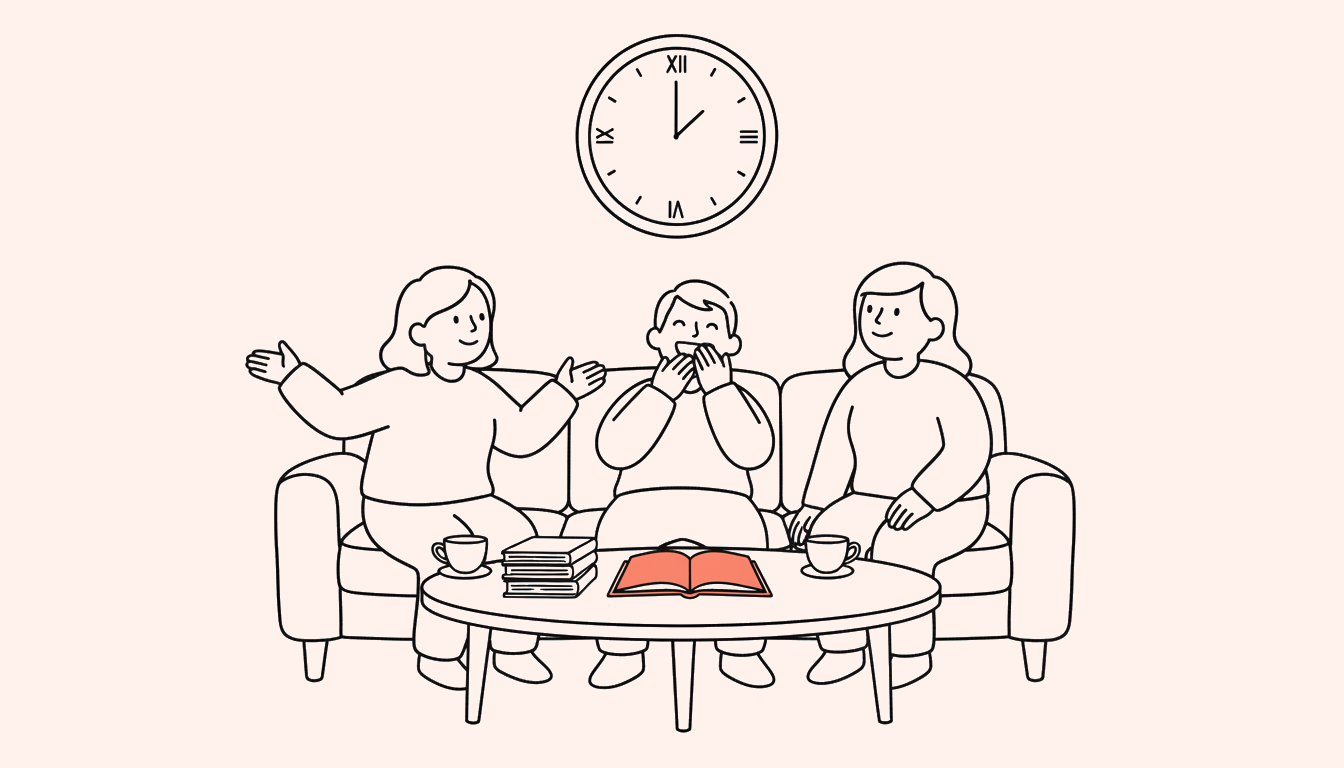
It's 9:45 p.m. Two people are checking their phones, someone is stacking plates, and the host is still on question four of twelve. Or the opposite: everyone sat down at 7, ran out of things to say at 7:40, and now you're all staring at the cheese board.
Meeting length is one of those things nobody plans until it goes wrong. The good news is that it's easy to fix once you know the numbers.
Most book clubs land between 90 minutes and 2 hours. That's long enough to settle in, talk through the book properly, and still have time to socialize. Short enough that nobody is wrecked the next morning.
Here's the quick version:
- 60 minutes: Works for lunch-hour clubs, workplace groups, virtual meetings, and small groups
- 90 minutes: The best default for most clubs — enough room for a real discussion without drag
- 2 to 2.5 hours: Right for social, in-person clubs that treat the meeting as an evening out, food and catching up included
The pattern across library guides and long-running clubs is consistent. The actual book discussion takes about 60 to 90 minutes. Everything else — arrivals, snacks, gossip, picking the next book — is what stretches a meeting from 90 minutes to a full evening.
That's the key insight. When you ask how long a book club meeting should be, you're really asking two questions: how long do you want to discuss, and how long do you want to hang out? Decide those separately and the total takes care of itself.
There's no universal right answer, but four things move the number up or down.
More people means more time, but not in a straight line. A group of five or six can cover a lot of ground in 75 minutes. A group of twelve needs close to double that to give everyone a turn, and the discussion usually gets shallower anyway.
If your meetings keep running long because everyone has something to say, look at the headcount first. Our guide on how many people should be in a book club covers where the sweet spot is and what to do when you're over it.
A tight 180-page classic like The Great Gatsby can fill a 90-minute meeting on its own, because the symbolism and the narrator question keep people arguing. A sprawling multigenerational saga like Pachinko gives you so much to cover — four generations, several countries, a dozen major characters — that 60 minutes will feel rushed.
A rough rule: the more plot threads and characters, the more time you need to get everyone oriented before you can get to the interesting questions.
In-person meetings run longer because the social part is built in. People arrive, hug, refill drinks, and wander. Virtual meetings run shorter because screen fatigue is real — most online clubs are happiest at 60 to 75 minutes. If you host online, our virtual book club tips have more on keeping energy up.
An after-work weeknight meeting should end by 9:00 or 9:30, whatever time it starts. A weekend brunch club can sprawl comfortably. A lunch-break workplace club has 45 minutes, period. Pick a start time that makes a natural end time obvious.
Structure is what keeps a meeting the length you planned. These are templates — adjust the minutes to fit your group.
| Time | What happens |
|---|
| 0–10 min | Arrivals, quick catch-up |
| 10–15 min | Rating round — everyone gives the book a score out of 10 |
| 15–45 min | Discussion, built around 3 to 5 questions |
| 45–55 min | Pick the next book and confirm the date |
| 55–60 min | Wrap-up |
This is tight, but it works. The rating round does a lot of heavy lifting — it surfaces disagreement right away, which gives you something to discuss. Use it with a smaller group, or when you know people are short on time.
| Time | What happens |
|---|
| 0–15 min | Arrivals, drinks, warm-up icebreaker |
| 15–25 min | Quick reactions — one-word summaries, favorite moment |
| 25–70 min | Deeper discussion, working through 6 to 8 questions |
| 70–80 min | Logistics: next book, host, date |
| 80–90 min | Closing question and goodbyes |
This is the one we'd recommend if you're not sure where to start. It leaves room for tangents without letting them take over.
| Time | What happens |
|---|
| 0–30 min | Arrivals, food, and unstructured catch-up |
| 30–40 min | Settle in, icebreaker, first reactions |
| 40–100 min | Book discussion |
| 100–110 min | Club business: next pick, schedule, hosting |
| 110–120 min | Open hangout |
Notice that the discussion portion is still about an hour. The extra 30 minutes is social time at the beginning and end. Giving that time a real slot, instead of letting it leak into the discussion, is what keeps a long meeting from feeling long.
If you want to go deeper on building the structure itself, our book club meeting agenda post breaks down each segment.
Overrunning is the more common problem. A few habits fix most of it.
Put the end time in the invitation. "7:00 to 9:00" gives people permission to leave and gives the host permission to wrap up. Open-ended meetings drift.
Pick your questions in advance — and then pick fewer. Most hosts bring twice as many questions as they need. Choose five or six you actually care about and treat the rest as backup. A question bank makes this quick.
Assign a timekeeper. Rotating the role is the simplest way to share the load. Someone glances at the clock at the halfway mark and the 15-minute mark. That's all it takes. Other roles that help are in our post on book club roles that share the workload.
Handle tangents with a parking lot. When a conversation veers off, say "great point, let's come back to that after we finish the discussion." Then actually come back to it. The group will let go of the tangent once they trust you'll return.
Don't let one voice eat the clock. If one or two people are taking most of the airtime, it's not just a fairness problem — it stretches the meeting. See how to lead a book club discussion without dominating for specific ways to redirect.
The opposite problem: you blow through your questions in 30 minutes and everyone looks at each other. This usually means one of three things.
- The questions are too closed. "Did you like the ending?" gets a one-word answer. "What would you have changed about the ending, and why?" gets ten minutes.
- The book was too easy to agree on. A book everyone loves can produce a short, warm, shallow meeting. Next time, pick something that's a little divisive.
- People didn't finish. When half the group is behind, they hold back to avoid spoilers. A clear spoiler policy helps, as does a plan for when nobody read the book.
A short meeting isn't a failure. If the group is happy and the conversation was good, 45 minutes is fine. But if you're regularly short, try adding a structured activity — a debate round, a "casting call" for the movie version, or a game from our list of book club games and activities.
Sometimes, yes. A short, dense book earns a shorter, more focused meeting. A long one deserves a longer evening — or a split across two meetings.
Some clubs deliberately schedule around this. They'll pair a long pick with a short one the following month, or choose a quick read for a busy season. Our list of best short books for book clubs is useful for exactly this. And if you're planning your whole year, the book club calendar planning guide shows how to balance heavy and light months.
For books with serious emotional weight, give yourself extra time. A story like Educated tends to open up personal conversations, and you don't want to cut those off at the 90-minute mark because someone has a babysitter waiting. If a book is likely to run deep, plan for a longer meeting or tell the group in advance.
Here's the simplest advice in this post: ask your members. Send a two-question poll — "What's the ideal meeting length?" and "What time should we end?" — and go with the answer. Clubs that agree on expectations up front tend to be the ones that last.
Then revisit it. A schedule that worked when the group had six people may not work at ten. Check in once or twice a year, and adjust.
Once you know how long you're meeting, the rest is filling the time well. That means questions that get people talking, a few icebreakers, and a snack plan that doesn't eat your prep time.
Search for your book on Instant Book Club and get a complete kit in 30 seconds — discussion questions, icebreakers, food pairings, and printable decorations, all sized for a meeting that fits your schedule. If you're hosting for the first time, our guide to hosting a book club meeting walks through the whole process, and you can browse ready-made kits for classics and other genres to find your next pick.
And if you want to save yourself the most time, see how to plan a book club meeting in 30 seconds. Or start with a book like Project Hail Mary and let the kit do the pacing for you.