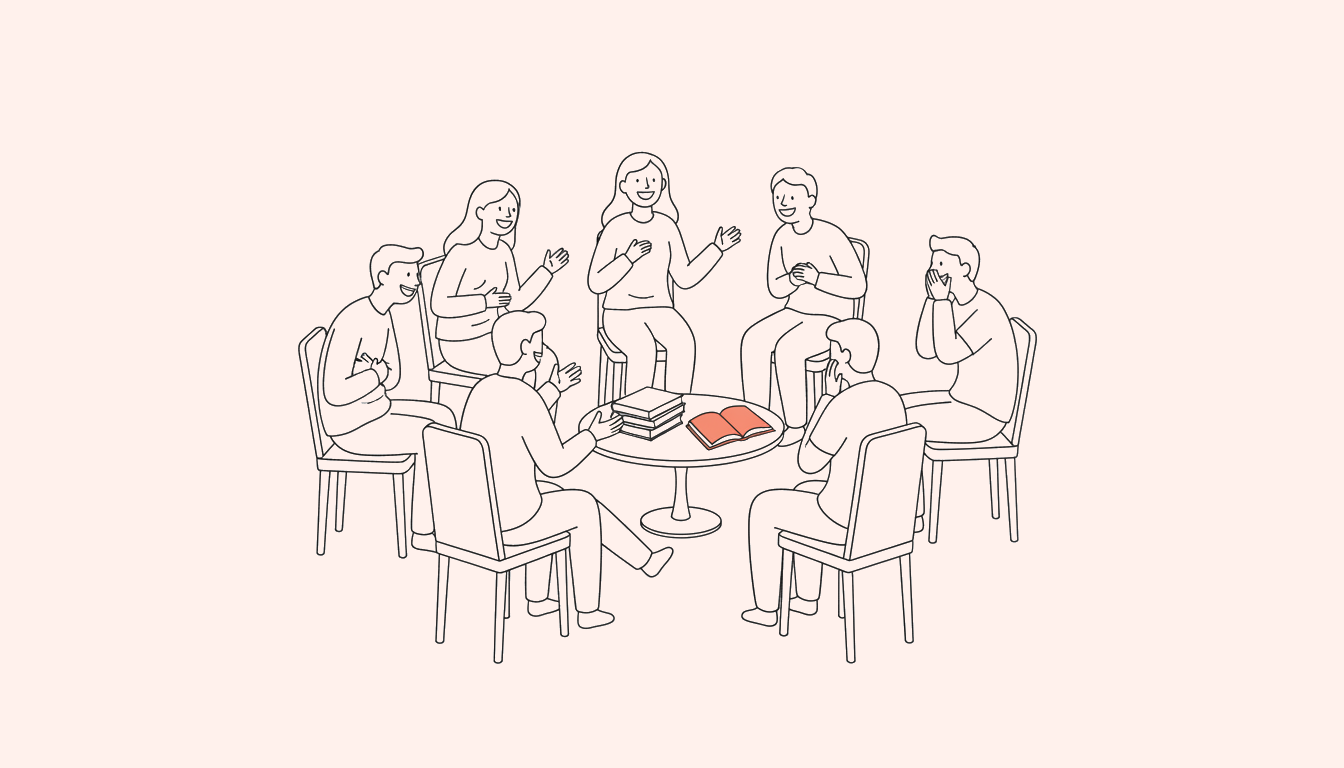
Most book clubs do not die because of a bad book. They die because of a headcount problem. Three people show up and the conversation fizzles by the second glass of wine. Or twenty people show up, the same four talk, and everyone else quietly checks their phone.
Size is the setting nobody thinks to adjust until the club is already struggling. Get it right and the discussion mostly runs itself. Here is what actually works, and what to do when your group is on the wrong side of the line.
If you want a single number, aim for eight to ten members. Most clubs that last for years land somewhere in the six-to-twelve range, and eight to ten is the sweet spot inside it.
The math is simple. Not everyone makes every meeting, so a roster of ten usually means six or seven people in the room. That is enough for real disagreement, a few different reading styles, and at least one person who loved the book you hated. It is also small enough that everyone gets to talk without fighting for airtime.
A few things shift the number slightly:
- Hosting at home: Count your seats honestly. Ten to twelve people is comfortable in most living rooms. Past that, someone is sitting on a stair.
- Meeting at a restaurant or cafe: Keep it under eight. Loud rooms punish big tables.
- Meeting virtually: Eight to twelve works well on video. Past fifteen, the grid gets tiny and people stop jumping in. Our guide to virtual book club tips covers how to keep an online group from feeling like a webinar.
Under five members, you are one scheduling conflict away from canceling. A club of four with two people out sick is just a coffee date with homework.
Small groups also have a diversity problem. When everyone shares the same taste and the same background, the conversation agrees with itself. That feels pleasant for about three meetings.
The upside is real, though. Tiny clubs are intimate. People talk about their lives, not just the plot. A group of four or five who genuinely like each other can have a better night than a group of fifteen who barely know each other.
If you are in this spot, a book with strong emotional pull helps carry a smaller room. Normal People is a good example — two characters, one relationship, and plenty to argue about over whether anyone communicates honestly. You do not need a crowd to fill ninety minutes with that one.
Past fifteen, the dynamics change. Side conversations start. The loudest three people become the whole discussion. The quiet readers, who often have the best insights, never find a gap.
Large groups also drift on logistics. Picking a book by vote takes forever. Finding a date that works for twenty people is a part-time job. And someone always arrives having read a different edition, or none of it.
If this sounds familiar, you have a few options before you start turning people away.
This is the cleanest fix. Divide the group into two clubs that read the same books on separate nights, or read different books entirely. You keep the community and fix the conversation.
Split by schedule rather than by personality. Weeknight people go in one group, weekend people in the other. It avoids hurt feelings and nobody feels sorted into a "good" or "bad" club.
If you want to keep one big gathering, break the room into small circles of four or five for the first half of the meeting. Give each table two questions. Then bring everyone back together and let one person per table report what came up.
This works especially well for a book that generates strong, divergent reactions. Verity is a natural fit — every table will land on a different answer to who is lying, and the reports back are half the fun.
Some members want a serious literary discussion. Others want wine, snacks, and a loose chat about the book. Both are valid, and trying to serve both in one room usually fails. Two clubs with clear identities beat one club with an identity crisis. Our breakdown of book club formats shows how different structures suit different groups.
If your numbers are low, resist the urge to blast an invite to everyone you know. Grow deliberately.
Add a few people at a time. A good rule is never more than double the group in one go. Going from four to eight is healthy. Going from four to twenty changes the culture overnight.
Invite for fit, not for fill. Ask each current member to bring one person they think would genuinely enjoy the group. Warm introductions beat open invitations because the new person already knows someone in the room.
Make joining easy. Tell new members the book, the date, and what to expect. If your club has unwritten rules, write them down. Our guide on how to start a book club walks through finding your first members, and it applies just as well to rebuilding one.
Use a milestone book. A hugely discussable pick is the easiest on-ramp for newcomers. The Seven Husbands of Evelyn Hugo has the kind of broad appeal that gets a hesitant friend to say yes.
Capping is awkward, mostly because it sounds like exclusion. It does not have to be.
Set a number early and say it out loud. "We keep the club at twelve so everyone gets to talk" is a reason, not a rejection. Keep a short waitlist and offer a spot when someone leaves. If the waitlist gets long, that is your signal to launch a second club and let one of your regular members host it.
You can also make the cap about the room, not the people. "My living room holds ten" is hard to argue with.
Here is the part most hosts miss: your club size and your meeting size are different numbers. Plan for the second one.
A roster of twelve with a typical turnout of seven is a healthy club. If your attendance regularly falls below half of your roster, the problem is not size. It is usually the schedule, the book selection, or burnout. Our tips on keeping a book club going cover how to fix that, and dividing the work with roles takes pressure off the person who always ends up organizing everything.
Track attendance for three meetings. If the room feels too crowded, you will see it in who stops speaking. If it feels empty, you will see it in who stops coming.
Size changes which books work best. A few rules of thumb:
- Small groups (4-6): Pick character-driven, emotionally dense books. They reward long, personal conversations. The Midnight Library is a strong choice.
- Mid-size groups (7-10): Anything works, but books with moral gray areas generate the best debate. The Nightingale gives a group of this size plenty to split on.
- Large groups (11+): Choose books with clear, discussable hooks so table groups have something concrete to chew on. Browse our book club favorites for picks that rarely flop.
If you tend to dominate in a bigger room, or want to keep a few voices from taking over, the techniques in our post on leading a discussion without dominating are worth a read. For the opposite problem, see how to handle difficult members before it sours the whole group.
There is no perfect size, only the right size for your room, your schedule, and your personalities. Start with eight to ten. Watch who talks and who goes quiet. Add people if the conversation feels thin, and split the group if it feels crowded.
Whatever your size, the easiest way to make every meeting work is to show up with strong questions ready. Search for your book on Instant Book Club and get a complete kit in 30 seconds — discussion questions, icebreakers, food pairings, and printable decor — whether you are hosting four people or fourteen. Pick the next title for your group and generate your kit tonight.