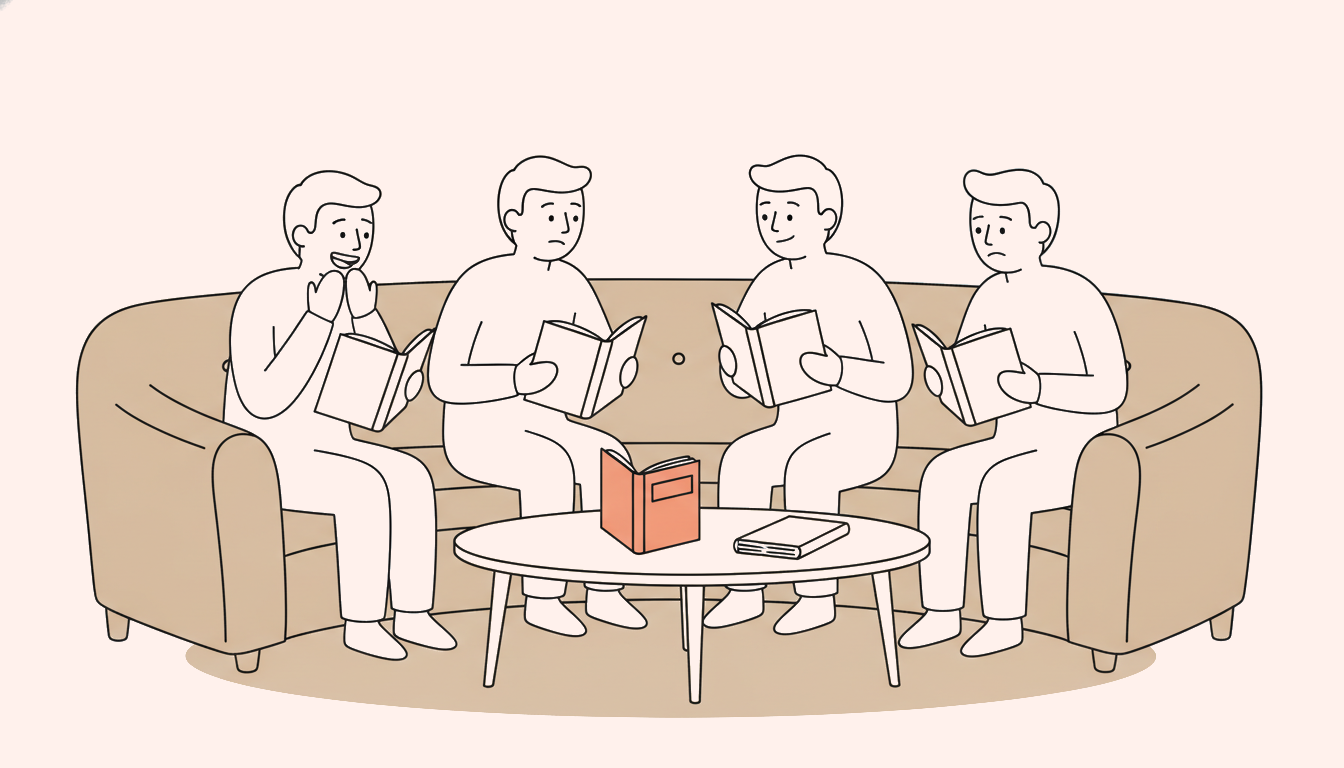
We've all been there. You spend an hour prepping the perfect spread of brie and crackers, you've got your discussion questions ready, and you look around the room only to realize that—through a collective failure of willpower—absolutely nobody actually finished the book.
The silence that follows is heavy. It's the sound of mutual guilt and the looming threat of a very awkward two-hour window where everyone just talks about their week instead of the plot.
But here's the secret: a "failed" reading month doesn't have to mean a failed meeting. In fact, some of the best book club bonds are forged in the shared chaos of a collective reading slump.
When you realize the group has hit a wall, the worst thing you can do is lean into the guilt. Avoid the "Who actually finished it?" interrogation—it only makes the non-readers shut down and the one person who actually read it feel like an outcast.
Instead, pivot immediately. The goal is to keep the social energy high while still honoring the idea of the book.
If nobody read the book, start with the vibe. Discuss the cover, the premise, and the general reputation of the author.
"I didn't finish it, but I love the aesthetic of the cover—it feels very gothic. Does that match the actual mood of the story?"
This allows people to contribute based on what they know about the book without feeling like they're failing a test.
If you're the host and you did read it, take the lead. Give a high-level, five-minute summary of the plot. Be generous with spoilers.
By removing the "spoiler anxiety," you give the others a framework to discuss the themes. You can ask, "The ending is a total shocker—do you think that makes sense given the characters' motivations?" Even if they didn't read it, they can engage with the concept of the twist.
When the conversation stalls, use these three structured pivots to keep the energy moving.
Sometimes the most interesting part of a book club meeting is why the group didn't read the book.
Was it too long? Was the prose too dense? Did a better book come along and steal everyone's attention? This often leads to a deeper conversation about the group's current reading tastes and habits.
If the book was a collective miss, use the time to curate the next few months. Go around the circle and have everyone share one book they've actually loved recently.
This is where you can introduce some high-impact reads. For example, if the group struggled with a slow literary novel, suggest something with a faster pace. Get the The Silent Patient book club kit for a psychological thriller that almost guarantees everyone will finish it.
If the book is a short one, or if there's a specific, pivotal chapter, challenge the group to read just those five pages right then and there. Set a timer for ten minutes, read the passage together, and then discuss it. It's a great way to bring the focus back to the text without the pressure of a 400-page commitment.
To prevent a repeat "zero-read" month, consider changing your selection process. Sometimes a group fails to read because the book didn't resonate with their current energy.
Try these strategies:
- Poll the group: Instead of one person picking, offer three options and let the group vote.
- Pick a "Safe" Bet: Every few months, choose a guaranteed page-turner. Get the Verity book club kit if you want a read that creates an immediate "must-finish" urgency.
- Set a "No-Pressure" Month: Explicitly label some months as "optional reads" where the focus is more on the social gathering than the literary analysis.
If you're looking for books that are practically impossible to put down, Get the Fourth Wing book club kit for a high-fantasy romp that keeps the group engaged. For something a bit more reflective, Get the The Midnight Library book club kit or Get the Circe book club kit to spark deep conversations about life and legacy.
The truth is, the "nobody read the book" phenomenon usually happens because the planning feels like a chore. When the preparation is seamless, the excitement for the book stays high.
Search for your book on Instant Book Club and get a complete kit in 30 seconds—including icebreakers that work even if the reading was spotty, and discussion questions that can pivot to the general themes of the story.
Related: