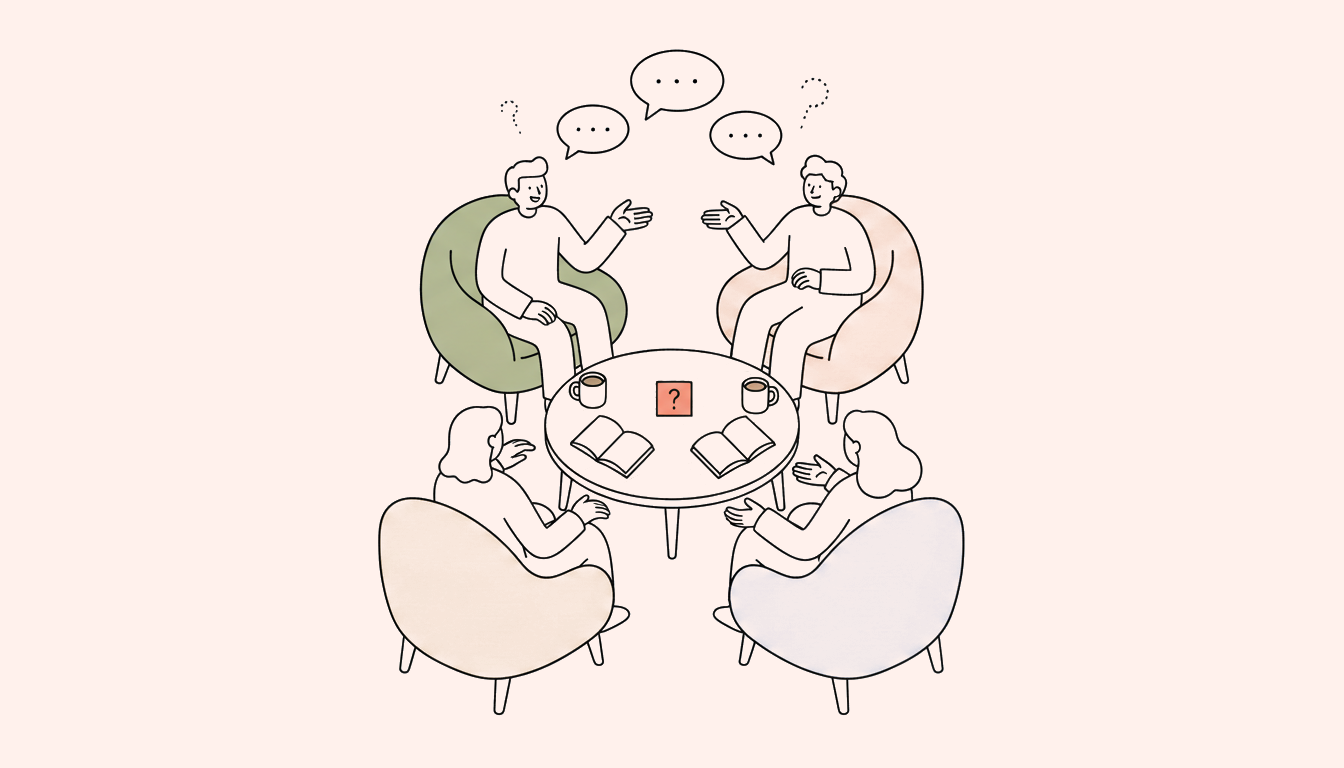
Most book clubs don't fail because people pick bad books. They fail because one person does all the talking.
If you're the one who founded the group, chose the book, or sent the calendar invite, it's easy to slip into the role of lecturer. You love the book. You've thought about it for weeks. You have opinions. But a book club isn't a presentation — it's a conversation. The best hosts aren't the ones who steer every answer; they're the ones who make everyone else want to speak.
Leading without dominating is a skill. It takes a little planning, some restraint, and a few simple techniques to redistribute the air in the room.
A strong host sets the tone, but the group does the work. When the host talks the most, members start performing for one person instead of talking to each other. The discussion flattens into a Q&A.
Quiet leadership means holding the structure while everyone else holds the conversation. You open the door, keep it open, and occasionally nudge people through. Your voice should be the least heard — and the most useful when it does show up.
This approach also scales. A member-led group, where people rotate hosting, works better when the "host" isn't treated as the expert. The role becomes facilitation, not authority. That's what keeps a club alive long-term.
The first five minutes matter more than most hosts realize. Use them to set expectations, not to summarize the book.
A good opening frame sounds like this:
- No recap test. Let people know they don't need to prove they read every chapter.
- No right answers. Emphasize that interpretation is the point.
- One voice at a time. Ask the group to be generous with space and avoid side conversations.
If your group is newer or has a mix of readers, add a quick reminder that spoilers are fair game once the discussion starts. That removes the awkward dance around plot points and lets people engage honestly.
A frame gives the group permission to participate without making anyone feel like they're being graded. It's the single easiest way to shift energy from host-centered to group-centered.
The first question sets the emotional temperature. Avoid anything that feels like an essay prompt.
Bad openers sound like test questions: "What is the author's purpose?" or "How does the setting reflect the theme?" Those put people on the spot.
Better openers invite reaction:
- "What surprised you most in this book?"
- "Which character did you change your mind about?"
- "Was there a moment that made you want to stop reading — or keep going?"
- "If you had to recommend this book to one specific person, who would it be?"
These questions don't have correct answers. They give people a personal entry point, which is what gets a quiet member talking.
Once someone answers, resist the urge to immediately add your take. Let their response sit for a beat. Often another member will pick it up before you do.
Dominant personalities are inevitable in any group. The host's job isn't to silence them — it's to redistribute their energy.
Use gentle, specific redirections:
- "That's a strong take — Alex, what's your read on that?"
- "Maria, you were quiet during the last point. What are you thinking?"
- "Let's hear from someone who disagrees."
- "Hold that thought — I want to make sure we get a few more voices in."
Don't apologize for cutting in. You're protecting the group, not policing it. The more neutral your tone, the less awkward it feels.
If one person consistently interrupts, talk to them privately after the meeting. Frame it around the group's health, not their personality. "You have great insights, and I'd love to hear more from other people too" lands better than a public correction.
This is where most hosts accidentally take over. A member gives an answer, and the host immediately explains why it's interesting, adds context, or pivots to the next question. That trains the room to answer the host instead of each other.
Instead, use follow-up questions that pass the ball:
- "What made you feel that way?"
- "Does anyone else see that scene differently?"
- "Can you give an example without spoiling the ending?"
- "Why do you think that stuck with you?"
Follow-up questions extend the conversation without owning it. They signal that you're curious, not that you're the authority. Over time, members will start using them on each other, which is the moment your club becomes self-sustaining.
Awkward pauses are part of good discussion. Most hosts panic and start talking. Don't. Silence usually means people are thinking, not that the conversation has died.
If a pause stretches too long, try naming it instead of filling it:
- "It sounds like that question landed. Take a minute."
- "That might be a heavier point than we expected. What else is coming up for people?"
- "Quiet is fine. Let's see what bubbles up."
This gives people permission to think out loud. The best insights often arrive after the silence, not before it.
If the host shares their opinion first, the conversation often bends toward agreement. Members will either echo you or decide the "right" answer has already been given.
Hold your own reading back until the group has developed theirs. This takes discipline, especially when you have a hot take. But it creates space for genuine disagreement and unexpected interpretations.
When you do share, frame it as one perspective among many:
- "I read it differently, but I love that we have two valid readings here."
- "My take is probably the unpopular one..."
- "I'm still torn on this, honestly."
That keeps you in the facilitator role even when you're participating.
A great discussion needs guardrails, not a syllabus. Plan three to five questions or themes in advance, but be willing to abandon them if the group latches onto something better.
A simple 90-minute arc:
- First 10 minutes: Social check-in and frame-setting.
- Next 20 minutes: First opener question and reaction round.
- Middle 40 minutes: Deeper questions, theme exploration, disagreements.
- Final 15 minutes: Recommendations, next book vote, closing thoughts.
- Last 5 minutes: Cleanup, calendar confirmation, casual chat.
This rhythm prevents the meeting from becoming a free-forall while still leaving room for spontaneity. If you need a more detailed structure, our book club meeting agenda template covers the same arc with built-in prompts.
One reason hosts over-talk is that they're carrying the discussion in their head. They feel responsible for every question, transition, and insight.
A better approach: offload the work. Use a pre-built kit with discussion questions, icebreakers, and food pairings so you can focus on facilitation instead of preparation. That external structure gives you confidence without turning you into the center of attention.
For example, if your group is reading Educated, you can get the Educated book club kit with ready-made questions that do the prompting for you. Same for The Nightingale — get the The Nightingale book club kit if your fall lineup leans historical.
A kit isn't a crutch. It's a release valve for the host's ego.
Some books naturally invite disagreement. Others are so universally loved or hated that the conversation stalls. As a host, you can shape participation by choosing books with moral complexity, unreliable narrators, or unresolved endings.
Good discussion books usually share one trait: they give every reader a slightly different experience.
If you want a thriller that divides rooms, get the The Silent Patient book club kit. For a literary pick that sparks debate about identity and ambition, get the Normal People book club kit. And if your group wants high-stakes fantasy with strong opinions on every love interest, get the Fourth Wing book club kit.
The book does half the facilitation work if you let it.
Book clubs disagree. That's the point. But when a disagreement gets personal, the host has to step in before the group fractures.
Start by validating both sides:
- "It's interesting — you both read the same book and landed in totally different places."
- "That's exactly the kind of split that makes this book worth discussing."
Then widen the circle:
- "Does anyone else land somewhere between these two reads?"
- "What evidence from the text supports either interpretation?"
If a debate gets heated, pause it with a question that returns to the book itself. Most arguments are more interesting when they're grounded in the text rather than in personal values.
For more on this, our post on how to handle book club disagreements breaks down specific scripts that keep debates productive.
The last few minutes should belong to the group, not the host. Wrap with a round-robin question — one sentence each — to make sure everyone closes together.
Good closing prompts:
- "One word to describe how this book left you."
- "Would you recommend this to a friend?"
- "What's one thing you're taking with you from tonight?"
Then confirm the next book, the next host, and the next date while everyone is still in the room. Decisions made in the moment stick better than follow-up texts.
If choosing the next book feels chaotic every time, delegate that decision too. Search for your book on Instant Book Club and pull up a complete kit in 30 seconds — discussion questions, food pairings, and printable decorations — so the next host doesn't start from scratch.
A great host isn't remembered for what they said. They're remembered for how the room felt — whether people left energized, heard, and curious about the next meeting.
If you find yourself talking less and listening more, you're probably doing it right.
Related: