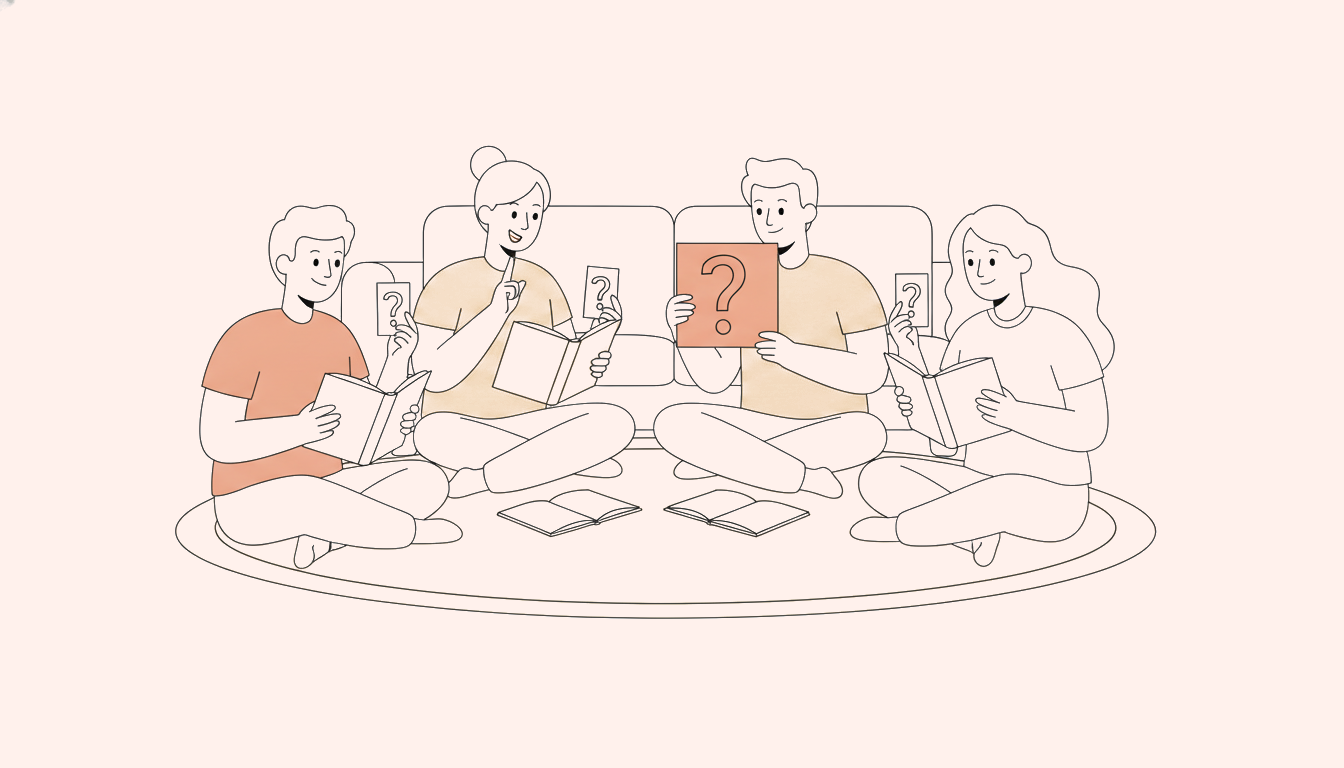
Nothing drains the energy from a book club meeting faster than someone blurting out the twist before everyone has finished. One minute the room is alive with theories — the next, three people are staring at the table wondering why they spent the last 300 pages paying attention.
Spoilers are a real friction point in book clubs. Reading speeds differ, life gets busy, and not everyone makes it to the final chapter by meeting night. The fix isn't to ban spoilers entirely. It's to make the rules obvious before anyone has a chance to break them.
A spoiler policy sounds formal, but it doesn't have to be. It's just a shared agreement about when plot details are fair game. Without one, every meeting carries a low-grade tension. The person who finished early walks in holding back. The person halfway through braces for impact. The host is stuck moderating in real time.
With a clear policy, the conversation flows. Members know exactly how much they can say and when. The group spends less energy managing reactions and more energy actually discussing the book.
The best time to set this policy is at your group's first meeting. The second-best time is right now.
There is no universal correct answer. The right policy depends on your members' reading habits and the genres you choose. Here are the approaches that tend to work:
Spoiler-free until everyone finishes. This is the safest default. No major plot points, twists, or ending details are discussed until every member confirms they've finished. It works for thrillers like The Silent Patient, where the entire reading experience hinges on the final reveal.
Spoiler-free first half, then open discussion. The meeting starts with broad questions — first impressions, character setup, themes — and then shifts into full-spoiler territory. Members who haven't finished can quietly bow out after the transition or simply listen without contributing. This works well for groups with mixed reading speeds.
Everything is fair game once the meeting starts. Some groups prefer total openness. If you choose this route, make it explicit. Members who show up without finishing know exactly what they're walking into. This can be a relief for groups that are tired of tiptoeing around the ending.
Whichever you pick, write it down. A short message in your group chat or a note at the top of your event invite is enough. The goal is clarity, not a legal document.
Enforcement doesn't have to be awkward. A good host treats spoilers as a logistics issue, not a character flaw. When someone starts down a spoiler-heavy road, a simple redirect keeps the meeting on track.
Try phrasing like: "Let's save that for the second half" or "Are we in spoiler territory now?" Most people don't want to spoil the book for others — they just need a gentle boundary.
It also helps to build in a progress check at the start of every meeting. Ask who has finished and who hasn't. It takes thirty seconds and prevents the most common spoiler mistake: assuming everyone is at the same place in the book.
The easiest way to protect the ending is to have a bank of questions that don't depend on it. These work for any book and any meeting stage:
- What was your first impression of the main character?
- How does the setting shape the story's mood?
- What themes are starting to emerge in the first half?
- Did the opening chapter hook you? Why or why not?
- How does the author's writing style affect your reading experience?
These questions keep the conversation moving without requiring anyone to reveal anything. For books where the ending is everything — like Verity or Gone Girl — this first-half structure is essential.
If your group wants deeper guidance, our book club discussion tips post has a full framework for keeping conversations balanced and engaging.
Group texts and Discord channels are where most accidental spoilers happen. Someone finishes early, feels something strongly, and posts a reaction that gives away more than they meant to.
Set a simple rule: anything past the agreed checkpoint gets a spoiler warning. On most platforms, that means writing "SPOILER" or "SPOILER BELOW" on its own line, then leaving a few blank lines before the actual detail. Don't rely on tiny disclaimers buried inside a long paragraph.
Better yet, create a dedicated spoiler channel or thread. Members who are finished can rant freely. Members who aren't can stay out until they're ready. This small structural change removes 90% of online spoiler friction.
The eager early finisher is a real type. They want to talk about the ending. They have theories. They might even feel like they're bursting. This is fine — as long as they have an outlet that doesn't hijack the group.
Two strategies that help:
Redirect them to a private space. A quick message like "Save that for the spoiler thread — I can't wait to dig in once I'm done" validates their excitement without forcing the rest of the group to listen.
Ask them to come with non-plot questions. If they want to contribute before the meeting, have them bring questions about theme, character, or craft that don't depend on the ending. This channels their energy in a useful direction.
For thrillers especially, the early finisher problem is acute. Books like Where the Crawdads Sing are designed around reveals that land better when everyone discovers them together.
Some books need stricter spoiler rules than others. A literary novel can often survive some early discussion of theme. A twist-driven thriller cannot.
When you announce your next pick, include a quick spoiler note:
- "This one is heavy on twists — we're going full spoiler-free until everyone finishes."
- "Mystery, but the themes are rich enough to discuss before the ending. We'll split into two halves."
- "Everyone finished early last time, so we're opening the floor from the start."
This keeps expectations aligned with the actual book instead of running every meeting under the same default rule.
Eventually, someone will slip. It happens. The host's job is to move the meeting forward without making the offender feel terrible or letting the moment derail the group.
A calm response works best: "Good to know — let's table that for later and talk about what we think is going to happen." Then redirect. The group will usually follow your lead.
If a major spoiler has genuinely ruined the meeting for several members, consider whether the group should reschedule the deep-dive portion or shift that book's full discussion to the next meeting. It's not ideal, but it's better than a room full of people pretending to care about an ending they already know.
New members are the most likely to break a policy they didn't know existed. When someone joins the group, send them the short version:
"We keep discussions spoiler-free until everyone finishes. We mark spoilers clearly in the group chat. If you finish early, jump into the spoiler thread instead of the main channel."
This takes two minutes and prevents the awkward correction later.
A book club is built on the shared experience of reading the same book at roughly the same time. Spoilers don't just ruin surprises — they break that shared experience. One person is reading a mystery, and another is reading a solved case.
A thoughtful spoiler policy protects the thing that makes book clubs worthwhile: the collective gasp, the argument, the slow unpacking of what just happened. For books that lean heavily on their endings, like Eleanor Oliphant Is Completely Fine or It Ends with Us, that protection is everything.
Once everyone has finished, the spoiler policy flips. Now the ending is the main event. The best meetings happen when your discussion questions are designed around the full arc of the book — and when your food, decor, and icebreakers match the reveal's energy.
If you want help planning a meeting that honors the book without spoiling it early, search your next pick on Instant Book Club. You'll get a complete kit with discussion questions, icebreakers, food pairings, and printable decorations in about 30 seconds. For more on running the meeting itself, see our guide to hosting your first book club or how to lead a discussion without dominating.