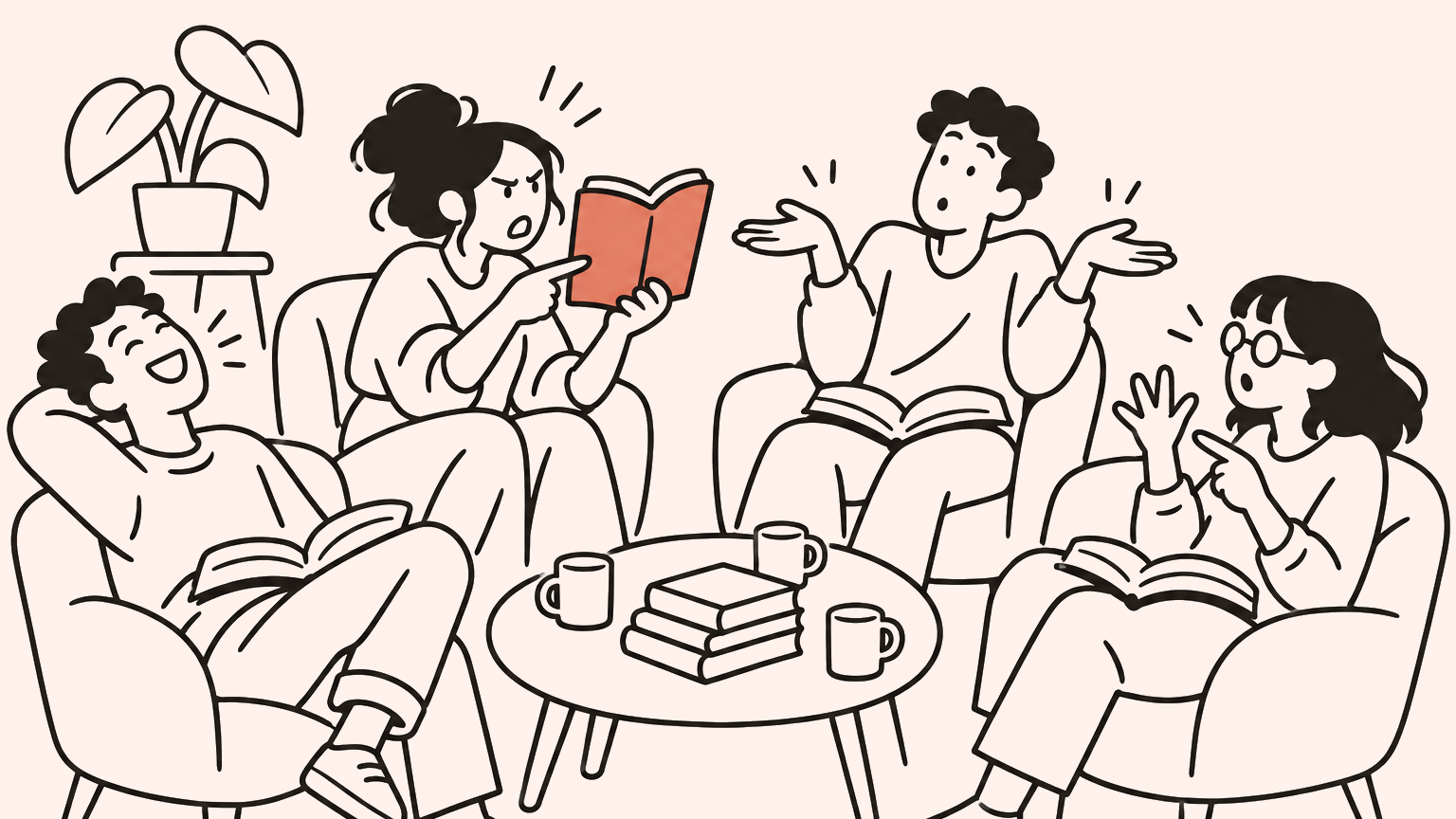
Someone always opens the meeting with the same sentence: "I just couldn't stand her." Then someone else says she was their favorite character in years. Now you have a room split down the middle and a host wondering whether to calm things down or let it run.
Let it run. A protagonist who makes people angry is one of the best things that can happen to a book club discussion, as long as you give the argument somewhere useful to go.
A character everyone loves gets a lot of nodding. A character who splits the room gets a real conversation, because people have to explain themselves. "I didn't like her" is an opinion. "I didn't like her because she lied to the one person who trusted her" is the start of an argument about the book.
The trouble is that "unlikeable" is a lazy word. It lumps together very different things: a character who is cruel, one who is selfish, one who is cold, one who is simply messy, and one who breaks rules people expected her to follow. Your first job as host is to pull those apart.
Start with one question: "What exactly did this character do that bothered you?" Make people name the behavior, not the vibe. You will find out quickly that two people who both said "unlikeable" meant opposite things.
There is a difference between not wanting to have dinner with someone and thinking the author did a bad job. Readers blur the two constantly, and that blur is where most of these discussions stall.
Try this framing at the top of the meeting: you are allowed to dislike a character and still rate the book highly. Say it out loud. It gives the people who loved the book but hated the narrator permission to speak, and it gives the people who bailed on the book permission to say why.
Then ask the sorting question: "Did the book want us to like this person?" Sometimes the answer is obviously yes, and the author fumbled it. More often the answer is no, and the discomfort is the point.
Keep a short list in your notes. These work for almost any book with a difficult lead.
- Where did you lose patience? Ask for a specific scene or chapter, not a general feeling.
- Did you ever change your mind? Many readers soften toward a character late in the book, and others harden. Both are worth hearing.
- What does the character want, and is it reasonable? A bad method for a human want makes a character interesting rather than villainous.
- Would you have done anything differently in their position? This one gets honest quickly, and sometimes quietly.
- Why did the author put us in this person's head? If the story were told from someone else's point of view, what would we lose?
- Would we have reacted the same way if the character had a different gender, age, or background? Be careful with this one and let people answer in their own time, but it consistently produces the most thoughtful answers of the night.
You don't need all six. Pick three, and let the group wander.
If you want to build a meeting around the topic itself, these are good picks from our kit library. Each one has a lead character or narrator that readers argue about, and each has a complete discussion kit ready to use.
Nick Carraway says he reserves judgment, then spends the whole book judging everyone. Gatsby, Daisy, and Tom are all hard to defend, and readers tend to land in very different places on which of them is worst. It is a short book, which makes it a good starting point when you want the argument more than the plot. Get the The Great Gatsby book club kit for questions on narrators you can't fully trust.
Connell and Marianne frustrate readers for opposite reasons. One keeps failing to say the thing that matters, the other keeps accepting treatment she shouldn't. The best question here is who deserves more of the blame, and you can expect the group to split. Get the Normal People book club kit for discussion questions on communication and class. Fans of the author can browse more at Sally Rooney's author page.
Evelyn makes ruthless choices and tells you so. Some readers admire her for it, others think the book lets her off the hook. It is a reliable way to find out what your group forgives and what it doesn't. Get the The Seven Husbands of Evelyn Hugo book club kit and add the questions about narration and consequence. More from the same writer is on the Taylor Jenkins Reid page.
Eleanor is rude, judgmental, and very funny, and the book asks you to notice why. This is the best example on the list of a character people dislike in chapter two and defend fiercely by chapter twenty. Get the Eleanor Oliphant Is Completely Fine book club kit if your group enjoys watching its own opinion shift mid-book.
This one divides readers hard, partly because of who they decide to believe. It is a strong pick for a group that likes to argue, with one caution: the best questions depend on the ending, so settle your spoiler rules before you start. Get the Verity book club kit for a full set, then read our guide on handling a book club spoiler policy if your group has mixed finishing speeds.
Arguing about a fictional person can slide into arguing about each other, especially when the character reminds someone of a real relationship. A few habits keep the room friendly.
Ask people to talk about the character, not about the people who disagree with them. "She seemed manipulative to me" works. "You're only defending her because you're like her" does not.
Give the quiet members the first word. The loudest reader tends to settle the verdict early. Go around the circle once with a single sentence each before opening the floor.
Watch for the identity trap. A reader who has lived something close to what the character did may feel the criticism personally. If the tone sharpens, slow down and ask what the book gets right about that experience.
For more on keeping a heated night useful, see our guides to how to handle book club disagreements and book club debate tips.
If you know in advance that the pick is divisive, structure the evening so the split helps you.
- Anonymous verdicts first (5 minutes). Everyone writes one word for the main character on a slip of paper. Read the slips aloud. The spread is your opening.
- Defend the person you disliked (15 minutes). Ask each reader to make the best case for the character they liked least. It is harder than it sounds and it changes minds.
- Author's choices (15 minutes). Move from the character to the craft: why this voice, why this ending, why make us stay in this head.
- The re-vote (5 minutes). Slips again. See who moved.
That last step is the one people remember. Watching a one-word verdict change over an hour is a small, satisfying proof that the discussion worked.
Sometimes "I hated the character" is code for "the book wasn't good." That is a different conversation, and it deserves its own space. If most of the room checked out, our guide on what to do when everyone hates the book club pick covers how to run that night honestly.
The test is simple. If people can still tell you exactly what the character did and why it mattered, the book is working. If nobody can remember the character at all, the problem is the writing.
Difficult characters are not a problem to manage. They are the reason people show up with opinions. Pick a book with a divisive lead, bring three of the questions above, and let the room do the rest.
If you want a full set of discussion questions, food pairings, icebreakers, and printable decorations for any of these books, search for your book on Instant Book Club and get a complete kit in 30 seconds. Browse the literary fiction genre page for more picks with characters worth arguing about.
Related: