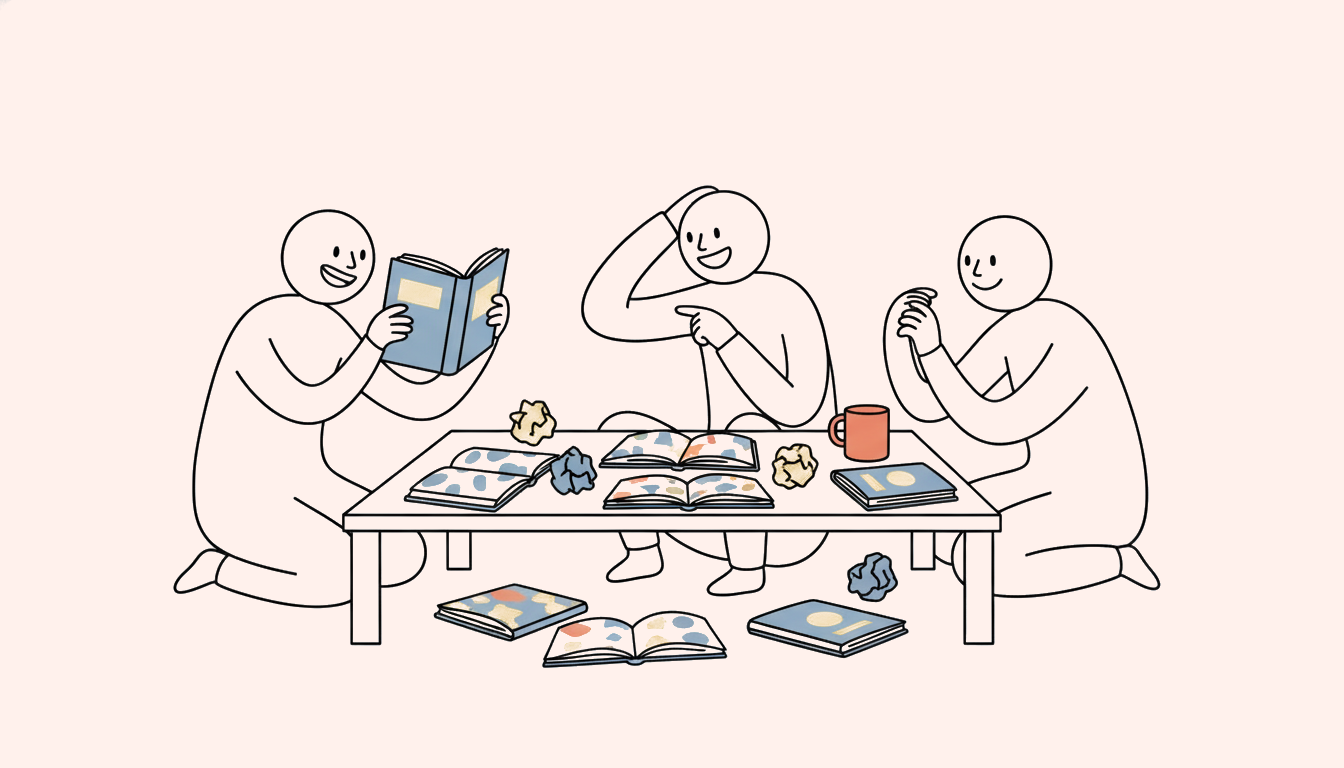
Every book club eventually hits the same wall: the chosen book lands with a thud. Maybe the prose was flat, the plot made no sense, or the main character made everyone want to throw the book across the room. Worse, half your group DNF'd it by chapter four and the other half only finished out of stubbornness. A bad pick can feel like a wasted month — but it doesn't have to be a wasted meeting.
The truth is, a universally hated book often produces one of the most energetic, honest, and memorable nights your group will have all year. The trick is leaning into the flop instead of pretending it isn't one.
You can usually tell a pick is bombing well before anyone shows up. The group chat goes quiet. Someone "forgets" to order the book. A few members start asking what you're reading next month. Don't ignore those signals — use them.
A few days before the meeting, send a quick message that resets expectations: "Sounds like this one didn't work for most of us. That's fine. We'll make the meeting about why it flopped rather than forcing a love letter to it." That one sentence removes the pressure to perform enthusiasm and gives people permission to show up even if they didn't finish.
If you're the host, take five minutes to skim the worst reviews online. Not to mock the author, but to see whether the problems your group noticed are common. Sometimes it helps to name the failure pattern: pacing issues, unlikeable narrator, misleading marketing, an ending that undercuts the whole book. Having language for why it didn't work makes the conversation sharper.
The second everyone walks in, acknowledge the elephant in the room. A light opener works better than a defensive one. Try: "So, should we throw this one in the sea or what?" or "On a scale of 'meh' to 'I want those hours back,' where did you land?"
A few ground rules keep the night fun instead of mean:
- No one has to apologize for not finishing. A DNF is data, not a character flaw.
- Separate the author from the book. Criticize the work, not the person who wrote it.
- Separate the picker from the pick. The member who suggested the book probably feels worse than anyone. Make it clear that bad picks happen to every club, every year.
Honesty without cruelty is the goal. You want people to leave saying, "That book was terrible, but the conversation was great."
Standard discussion questions fall flat when nobody liked the book. Asking "What was the central theme?" to a room full of eye-rolls is a fast way to kill the energy. Instead, run a book autopsy. The goal isn't to find hidden genius — it's to figure out exactly where the book went wrong.
Open with the moment people checked out. "At what page or chapter did you realize this wasn't going to get better?" This usually surfaces the book's core problem quickly. Maybe the dialogue turned wooden, the twist was obvious, or the protagonist made a decision that broke believability.
For a twist-heavy book like Verity, a failed twist is a special kind of disappointment. If the reveal felt unearned, the whole novel collapses. Compare that with a character-driven book like It Ends with Us, where the turning point usually lands emotionally even when people disagree on the ending.
Some books have a great idea and terrible delivery. Ask: "Was the concept promising, or was it doomed from the synopsis?" and "Where did the execution fall short of the premise?"
This question is useful because it gives the picker something to hold onto. They may have picked the book for the idea, not the writing. The group can agree the premise sounded good while agreeing the author botched it.
When readers hate a book, they usually hate the characters first. Try: "Who was the most insufferable character, and what was their worst moment?" or "Did any character make a choice that made logical sense?"
Books like The Silent Patient rely on the reader wanting to understand the protagonist. If that connection never forms, the suspense doesn't land. In contrast, a memoir like Educated can survive unlikable family members because the narrator's growth keeps you anchored.
If the conversation starts circling the same complaints, move into an activity. A hated book is a perfect excuse to break your usual format.
The 1-Star Review Game. Pull up dramatic one-star reviews on your phone and read them aloud without naming the reviewer. Vote on which review best captures the group's frustration. It almost always gets people laughing.
The Rewrite. Give everyone three minutes to pitch a new ending, a deleted subplot, or a recast main character. The worse the ideas, the better the energy. "What if the butler did it, but also aliens landed?" is a perfectly valid contribution.
The Casting Challenge. If Hollywood forced an adaptation, who would play the lead? Which director could salvage it? This works because it shifts the conversation from what the book is to what it could have been.
The Palate Cleanser Round. End the book talk by having everyone recommend one book that covers the same theme or genre but does it well. You walk away with a better reading list and a clear direction for next month.
The most important hosting skill in a flop meeting is protecting the member who suggested the book. Even if the group is roasting the novel, make sure the picker doesn't feel roasted.
A few ways to do that:
- Thank them for taking the risk. Picking books is hard, and safe choices are rarely memorable.
- Find one thing they got right. Maybe the cover was beautiful, the synopsis was compelling, or the genre was a smart direction for the season.
- Rotate the blame. If your club picks books by vote, remind everyone they all signed off on it.
A bad pick handled well strengthens the group. A bad pick handled badly makes people stop suggesting books altogether.
After a disaster, your club needs a win. Don't swing to another ambitious literary experiment. Choose something short, propulsive, and broadly likable. A cozy mystery, a page-turning thriller, or a beloved book club favorite gives everyone a chance to remember why they joined.
A few reliable palate cleansers from the cache:
If you want help picking something your specific group will actually finish, search for your next book on Instant Book Club and get a complete kit — discussion questions, food pairings, icebreakers, and printable decorations — in about 30 seconds.
Not every flop meeting needs to run the full two hours. If the book talk peaks at forty minutes, let it peak. Shift to snacks, catch-up, or picking next month's book. Forcing a longer discussion on something nobody enjoyed makes the night feel like punishment.
Set a loose timer in your head. Give the book its honest thirty to forty minutes, then move on. Your group will thank you.
Some clubs lean into the flop by keeping a running "worst picks" list or awarding a playful trophy. That might not be your group's style, but the principle is worth stealing: bad books are part of the process. Treating them as shared jokes rather than secret failures makes the club feel safer.
The clubs that last are the ones where someone can say, "I hated every page," and the room responds with curiosity instead of awkward silence.
Related:
Bad books happen to good clubs. The meeting after a bad book is where hosting matters most. Search for your book on Instant Book Club and get a complete kit — discussion questions, food pairings, icebreakers, and printable decorations — so you can spend less time scrambling and more time actually talking.