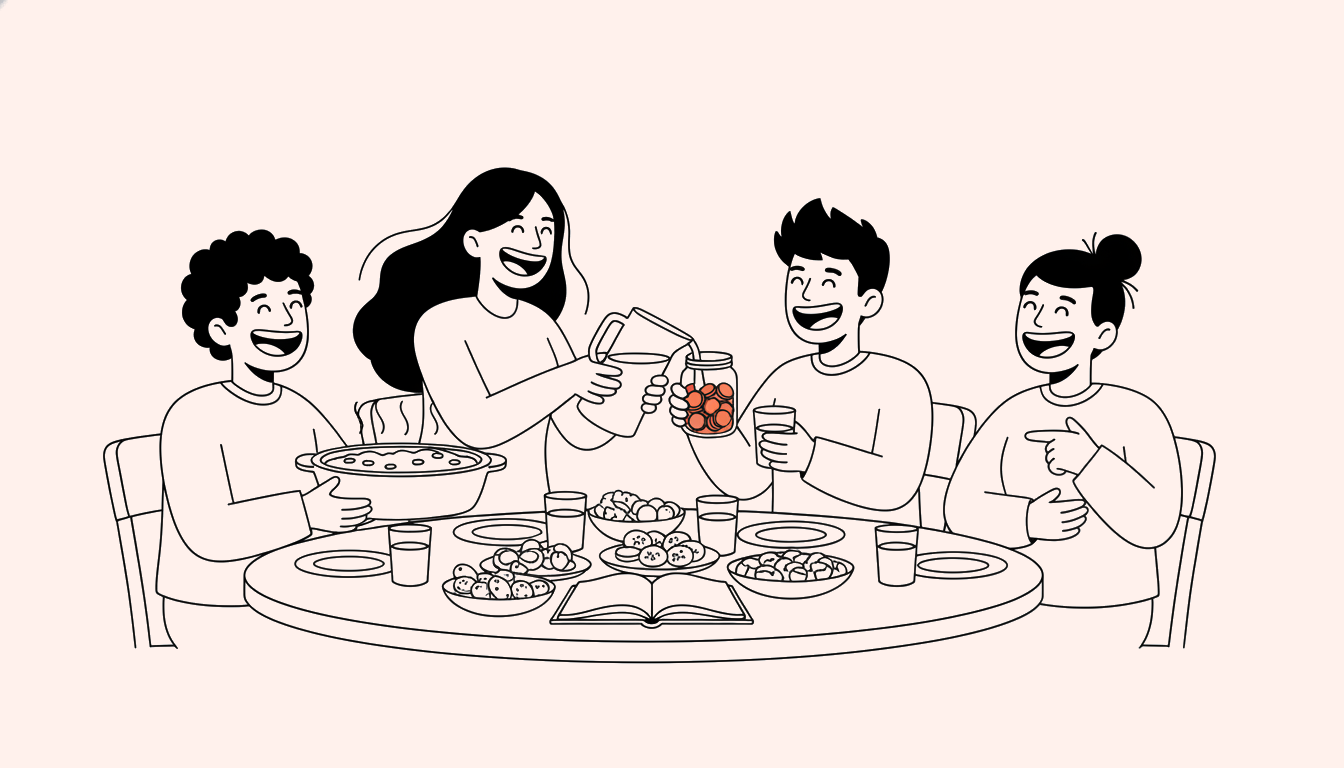
Nobody joins a book club to talk about money. But around month four, someone notices that the same person has hosted three times, bought the wine every time, and quietly stopped smiling when the group says "it's no trouble."
Costs are the unspoken thing that ends friendly clubs. The fix isn't a spreadsheet or a bylaws document. It's picking a simple system early and saying it out loud.
Before you split anything, it helps to see what you're splitting. Most clubs have four buckets:
- Food: snacks, a cheese board, or a full dinner, depending on how ambitious your club is
- Drinks: wine, coffee, sparkling water, or something themed
- Books: the actual copies, which vary a lot by pick
- Extras: printed discussion questions, decorations, a venue fee if you meet at a café or private room
For a living-room club, food and drinks are the real number. For a club that meets at a restaurant, it's whatever people order. Books are the sneaky one — five members buying a new $28 hardcover each month adds up faster than any cheese board.
The goal of any cost system is the same: no single person quietly absorbs the bill. Here are six ways to make that happen.
This is the classic. One person hosts, supplies snacks and drinks, and the next month someone else takes a turn.
It works because it's simple and it evens out over time. Everyone pays roughly the same across a year, in the form of a few hosting nights instead of a monthly contribution.
It breaks down when the club has uneven hosting capacity. Someone with a tiny apartment hosts once and never again. Someone with a big house hosts every third month and starts to feel like the venue. If that sounds familiar, the fix is to separate the space from the spending — see options 2 and 3.
Keep the host's bar low, too. Our guide to book club food ideas is full of snacks that cost under $20 and look like you tried.
Everyone brings something. The host provides the space and maybe a drink; the group covers the rest.
The potluck is the most budget-friendly format, and it spreads the effort as well as the cost. The only real risk is eight bowls of chips.
A shared sign-up sheet — or a quick message in your group chat — fixes it. Ask people to claim a category: savory, sweet, drinks, or something fresh. You don't need to micromanage the menu. You just need to avoid duplicates.
Potlucks also pair well with a theme. If you're reading The Midnight Library, a "choose your own life" snack table where everyone brings a dish from a different imagined life is more fun than it sounds, and nobody's budget has to stretch.
This is the hybrid, and for many clubs it's the sweet spot. The host opens their home, and a small contribution from each member — usually $5 to $10 — covers the snacks and drinks.
You can collect it in a few ways:
- A jar by the door. Low-pressure, no apps.
- A payment app. Fast and traceable if the host is buying ahead of time.
- A monthly "kitty." Everyone puts in once and the treasurer draws from it.
Whichever you choose, tell new members at the start. Walking into a meeting and getting asked for $8 is awkward. Reading "we each chip in $8 for snacks" in the welcome message is not.
Drinks are often the biggest line item. A BYOB policy removes it entirely: everyone brings what they want to drink, and the host covers only food.
This also solves a quiet fairness problem. Some members drink wine, some don't, and nobody should subsidize a bottle they didn't touch. If you go BYOB, make sure there's still a pitcher of water and something non-alcoholic on the table so the non-drinkers aren't left out.
For themed nights, a loose request works better than a rule. "Bring something that fits the book" gives people direction without a shopping list. Our food and drink pairing guide has ideas by genre.
If your club meets at a café, a library room, or a private room at a restaurant, the math changes. Now there's a real venue cost, and a flat contribution is often fairer than splitting a bill.
A few ways clubs handle it:
- Pay for what you order. The default for restaurant and café meetups. Zero admin.
- A flat per-meeting fee. Useful if the room has a booking charge.
- Optional donations. Some clubs pass a hat to cover a room rental rather than requiring a fee, which keeps the door open for anyone on a tight budget.
If you do collect dues, name one person as the keeper and tell the group what the money covers. Transparency is the whole game here. For more on picking a location, see our post on where to host a book club.
Food gets all the attention, but books can quietly cost more. A club that reads a new hardback every month asks each member for a real commitment before anyone has said a word.
A few ways to bring it down:
- Use the library. Most libraries offer print, e-book, and audiobook copies, and many will hold multiple copies for book clubs. Your club can also welcome audiobook listeners so nobody has to buy a copy to join.
- Pick paperbacks and older titles. A book that's been out a few years is cheaper, easier to find used, and often on library shelves. Educated and Eleanor Oliphant Is Completely Fine are both widely available in paperback and used copies.
- Mix in a classic. The Great Gatsby is short, widely available, and in the US public domain, so you can read it free online. It also gives a group plenty to argue about.
- Rotate a "free" month. Once a quarter, pick a book from the library or a public domain title so the cost drops to zero.
Browse the book club favorites collection to find popular picks that are easy to find in paperback or at the library.
The hardest part isn't the system. It's the first sentence. Here's how to keep it light.
Frame it as fairness, not money. "I want to make sure hosting doesn't land on the same two people" lands better than "we need to talk about costs."
Offer a default, not a debate. Instead of "how should we handle this?", try "I'm thinking we rotate hosting, host does snacks, everyone brings their own drinks — does that work?" Most groups will say yes in thirty seconds.
Do it at the start. The best time to set expectations is when the club forms, or when a new member joins. The second best time is right now, before resentment shows up.
Say the cap out loud. If hosts are expected to spend more than $20 to $25, someone will feel they have to match it. A stated "keep it simple" norm gives everyone permission to put out a bag of pretzels and a good conversation. The same applies to gift swaps — in our holiday party ideas, we suggest a firm $15 to $20 limit for exactly this reason.
If you're sorting out the bigger structure of your club at the same time, our guide on how to organize a book club covers schedules, picks, and expectations in one place.
Money isn't the only thing that piles up on one person. Setup, cleanup, picking questions, and sending reminders are costs too — they're just paid in time.
If you're splitting dollars fairly, split tasks fairly as well. Book club roles like timekeeper, question lead, and snack coordinator keep any single member from carrying the whole thing. And if you want a quick read on whether your club is built to last, see how to keep a book club going.
One expense people forget is the hours a host spends writing discussion questions, planning food, and pulling the evening together. That's real effort, and it's the main reason hosts burn out.
Search for your book on Instant Book Club and get a complete kit in 30 seconds — discussion questions, icebreakers, food pairings, and printable decorations — so the host's job is showing up with a cheese board, not building a whole meeting from scratch. Pick something like Project Hail Mary or Normal People and the prep work is already done.
Whichever system you choose, the best one is the one you actually say out loud. Find your next pick and get your kit, then pour something and start talking.