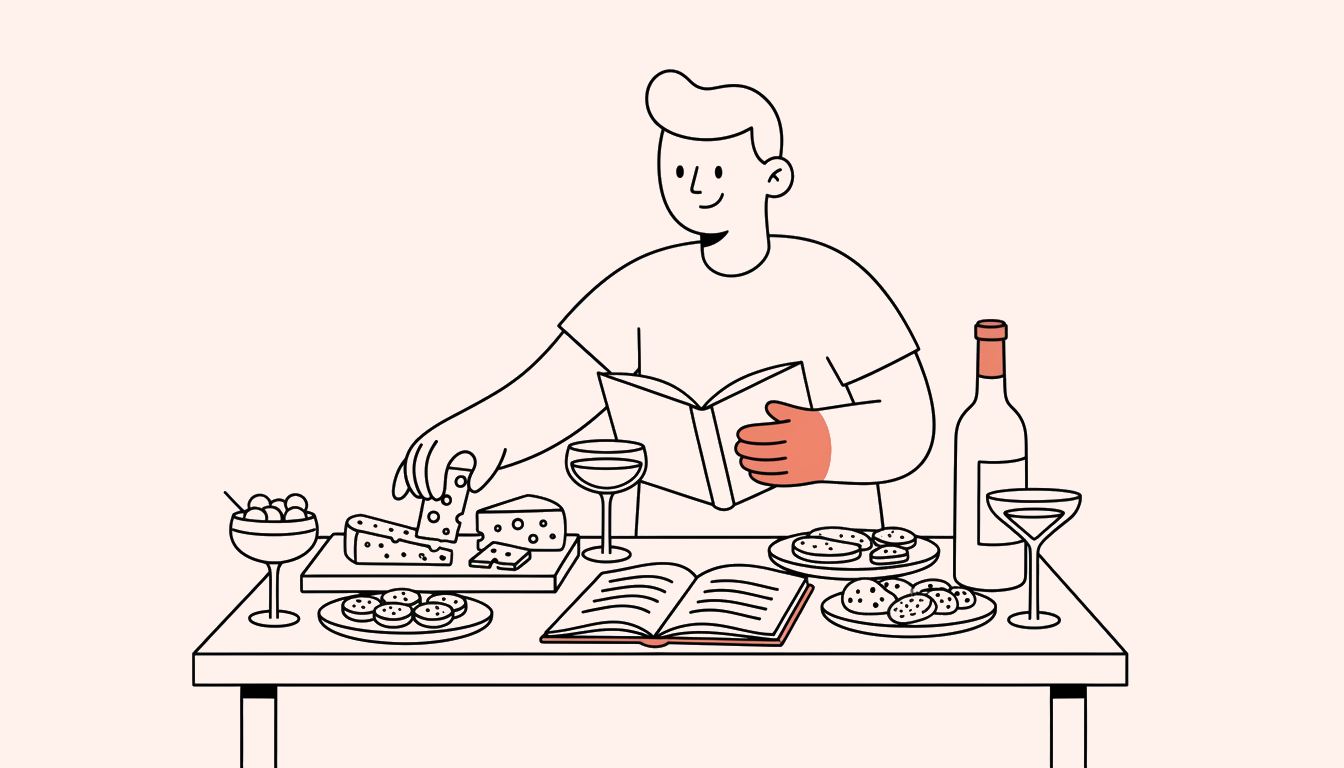
Nobody remembers the meeting where someone put out a bowl of chips. They remember the one where the host served Greek mezze for Circe, or charcuterie styled after Old Hollywood for The Seven Husbands of Evelyn Hugo.
Themed food doesn't have to be elaborate. A few deliberate choices — a cocktail that matches the era, a snack that nods to the setting — transforms a discussion into an event. And it shows your members you put thought into the evening, which makes them want to keep coming back.
Here's how to do it without spending half your weekend on Pinterest.
You don't need to match every dish to a plot point. Just pick one angle and run with it.
Where does the book take place? That's your starting point.
A novel set in 1970s New York calls for Manhattan cocktails and deli-style pickles. A story set in rural France means wine, crusty bread, and a wedge of Brie. A book set in Japan invites edamame, rice crackers, and sake or green tea.
This approach works because it's intuitive — guests immediately understand the connection — and it doesn't require you to read too deeply into the plot to pull it off.
When does the book take place? Historical fiction and literary novels set in a specific decade are begging for this treatment.
1960s: Deviled eggs, a cheese ball with crackers, anything Jell-O. Gin gimlets or whiskey sours. Think Mad Men, because that's probably what the characters were eating.
1970s: Fondue, spinach dip in a bread bowl, Quiche Lorraine. Harvey Wallbangers or Tequila Sunrises.
Victorian or Edwardian: Finger sandwiches, scones with clotted cream, shortbread. Earl Grey tea. You know the vibe.
Ancient or mythological settings: Olives, flatbread with hummus, figs, honey, roasted nuts. Wine — always wine.
Some books don't have a clear geographic or temporal anchor. In that case, match the emotional register.
Dark, tense thriller? Rich, indulgent food — a chocolate fondue, a bottle of red, nothing that requires cheerful appetite. Warm, cozy read? Baked goods, a pot of soup, mulled cider. Romantic, escapist novel? Something pretty and a little extra — prosecco, strawberries, small pastries.
The mood match is underrated because it reinforces the feeling people had while reading. A cozy book paired with cozy food creates a complete sensory memory of that evening.
Sometimes the right pairing is obvious once you think about it. Here are a few that work especially well.
The daughter of Helios learning to shape her own power — this one calls for an ancient Greek spread. Get the Circe book club kit →
Food: Mezze board with hummus, tzatziki, dolmas, pita, feta, and olives. Fresh figs if you can find them.
Drinks: Greek wine (Assyrtiko or a good Santorini white), or a honey-rosemary cocktail with gin and lemon.
Details that stick: Pour the wine into ceramic or earthen-looking vessels if you have them. Light candles. It costs nothing but sets the mood perfectly.
Old Hollywood glamour across five decades. The whole aesthetic of this book screams vintage cocktail party. Get the Evelyn Hugo book club kit →
Food: Classic charcuterie with prosciutto, Manchego, and cornichons. Shrimp cocktail. Caprese skewers. Things that look good on a tray at a party.
Drinks: Negronis or champagne cocktails. If you're feeling ambitious, a Sidecar — peak 1940s Manhattan energy.
Details that stick: Put on a Frank Sinatra or Chet Baker playlist. Ask members to come dressed in their "old Hollywood" look. Optional — most people love it.
A 1970s rock band, told through oral history interviews. Exactly one era of food, no guesswork required. Get the Daisy Jones & The Six book club kit →
Food: Fondue (this was peak fondue era), spinach artichoke dip, finger sandwiches, anything retro. Cheese and crackers with grapes. Deviled eggs.
Drinks: Tequila Sunrises, Harvey Wallbangers, or just cold beers with lemon wedges. Keep it unpretentious — these are rock musicians.
Details that stick: Play Aurora (the fictional album) or pick a 1970s rock playlist. Ask members: "Who was your Daisy?" before the meeting starts.
A 1960s chemist who becomes a cooking show host. The food practically writes itself. Get the Lessons in Chemistry book club kit →
Food: Anything from Elizabeth Zott's kitchen — think mid-century American classics. A chicken dish with herbs (she'd explain the Maillard reaction). A proper tossed salad. Deviled eggs again, because it's the '60s.
Drinks: Classic martinis or whiskey sours. Or just put out sparkling water and explain the exact chemical reason carbonation pairs with protein-heavy foods. Elizabeth would approve.
Details that stick: Write the menu as a chemistry equation. "Ethyl alcohol + citrus juice + ice = happiness." Your group will find this funny or groan — either way, it's memorable.
Contemporary Irish literary fiction — not the flashiest setting for themed food, but that's actually an advantage. Get the Normal People book club kit →
Food: Keep it simple and honest. Brown bread with good butter, sharp Irish cheddar, a proper Irish cheese board. Sausage rolls or a savory quiche.
Drinks: Guinness or Irish whiskey. Jameson with ginger ale is approachable and works well. Alternatively, Irish breakfast tea with milk.
Details that stick: The lack of flash is the point. Sally Rooney's writing strips everything down to the emotional core — your food can do the same. Simple things done well beat elaborate things done adequately every time.
Not every book has an obvious food angle. Contemporary literary fiction set nowhere specific, nonfiction, genre novels that could be anywhere — for these, lean on universal themes.
If the book has a villain or moral ambiguity: Serve things that are a little dangerous. Dark chocolate. Spicy dishes. A smoky cocktail. Food that doesn't entirely behave.
If the book is hopeful or redemptive: Something warm and homemade. A soup or stew. Baked goods. Comfort food has never steered anyone wrong.
If the book is buzzy and contemporary: Wine and cheese, charcuterie, good crackers with interesting dips. The meeting staples exist for a reason — they're reliable, crowd-pleasing, and easy to scale up or down.
If you genuinely have no idea: Search for your book on Instant Book Club and let the kit generate specific food and drink pairings for you. It pulls from the setting, tone, era, and themes of the book — and explains why each pairing works, which gives you something to talk about.
Food carries most of the theming work, but drinks seal it. A few principles:
One signature drink. Even if you're serving wine and beer, have one cocktail or mocktail that matches the book. Put the recipe on a card. Name it after a character. People take photos of this every time.
Offer a non-alcoholic version of everything. Don't make members feel awkward. A mocktail that mirrors the signature cocktail (sparkling water + the same juice and garnish) requires almost no extra effort.
Wine works for almost everything. Red wine with rich, meaty books. White or rosé with lighter, coastal, or summer reads. Champagne for anything triumphant.
Beer works too. Especially for casual groups, sports-adjacent books, or anything working-class in setting.
Tea is underused. For British novels, historical fiction, cozy mysteries — tea service feels genuinely special and requires zero mixing skills.
If you're hosting tonight and you haven't thought about food until now, here's a plan that always works and requires only a grocery store trip:
- Cheese board: Two cheeses (one sharp, one soft), crackers, grapes, and a handful of nuts. Takes 8 minutes. Looks great.
- One hot element: A store-bought brie baked with jam and pastry, or a jar of artichoke dip warmed and served with pita chips. Under 15 minutes.
- Drinks: Wine or sparkling water, a lemon, some ice. Done.
That's it. This is a better spread than most people expect, it requires no cooking, and nobody goes home hungry.
The best themed food isn't about impressing anyone. It's about giving your members a complete experience — a reason to be there, in that room, reading that book together, instead of just reading it alone.
Instant Book Club generates themed food and drink pairings for any book: specific recipes, pairing explanations, and ideas for building a spread around your pick. It takes the guesswork out of the planning so you can focus on the part that actually matters — the conversation.
Also worth reading: