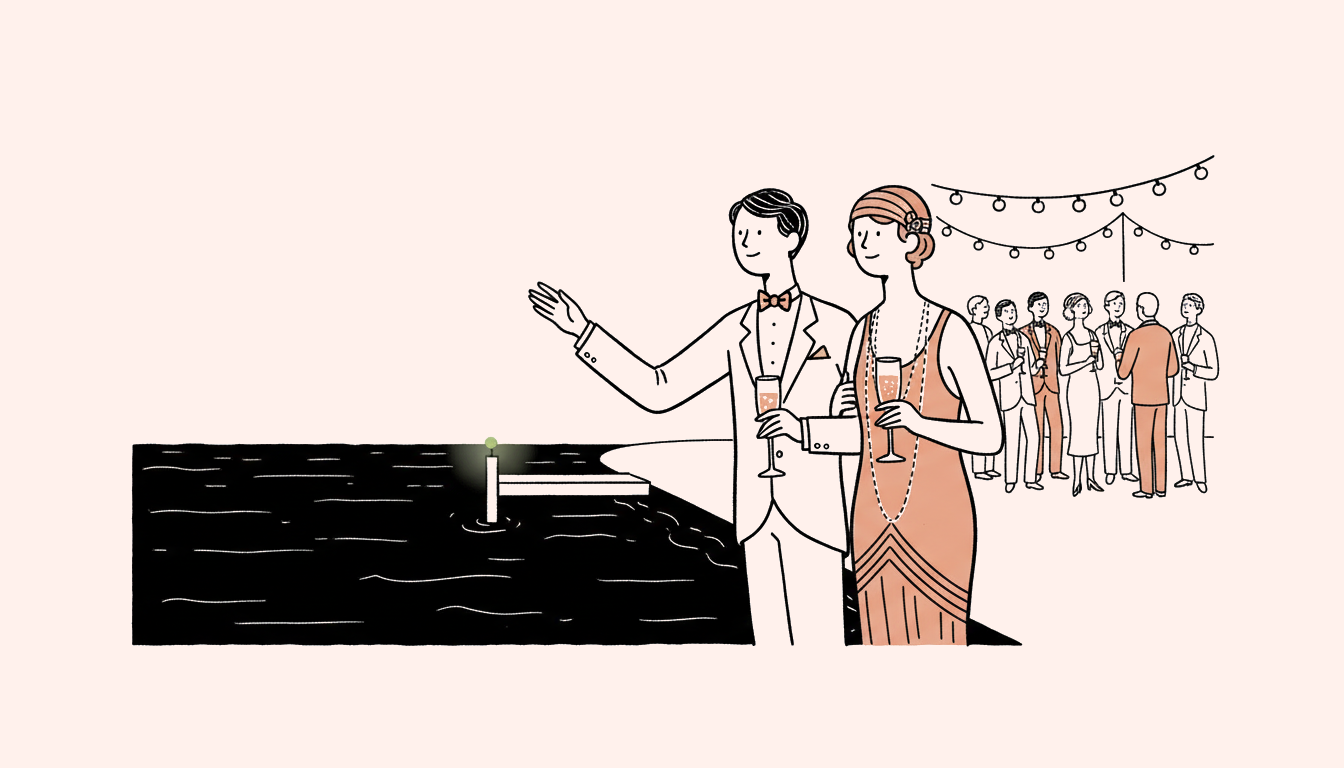
Most people read The Great Gatsby in high school. Coming back to it as an adult with a book club is a completely different experience — because now you've seen enough of life to understand what Fitzgerald was actually arguing about.
The questions below are designed to go past "what's the green light mean?" and into the arguments worth having: about ambition, class, love that's mostly projection, and what people destroy when they refuse to stop reaching.
This is the big one. Most discussions stay at the surface ("Gatsby symbolizes the American Dream"). Push your group past that.
- The novel is often taught as a critique of the American Dream. Does your group read it that way — or as something more complicated, like grief for a dream that never quite existed?
- Gatsby reinvents himself completely: new name, new money, new life. Is that admirable, pathetic, or both? Where does ambition stop being inspiration and start being delusion?
- Tom and Daisy have old money; Gatsby has new money; George Wilson has none. How does Fitzgerald use these three positions to structure the novel's moral argument?
- In 2026, does the America in Gatsby feel more distant or more recognizable than it did when you first read it?
- The phrase "the American Dream" doesn't appear in the novel. Does that absence matter?
Gatsby is one of the most analyzed characters in American fiction, and yet people still argue about who he actually is.
- Nick calls Gatsby "great" at the end. Do you agree with that judgment? What makes a person "great" in the novel's terms?
- Is Gatsby in love with Daisy, or in love with what Daisy represents? Can you separate those two things?
- He runs an illegal operation, lies constantly, and builds his entire identity on a fabrication. At what point, if ever, did you stop rooting for him?
- The novel gives us very little of Gatsby's interior life directly — almost everything is filtered through Nick's impression of him. Does that make him more mysterious or just more opaque?
- If Gatsby were alive today — same drive, same willingness to do whatever it takes — what would he be doing?
Get the Great Gatsby book club kit for icebreakers, themed food pairings, and printable extras that set the right atmosphere for this conversation.
The supporting characters in Gatsby are often flattened into symbols. They're more complicated than that.
- Tom Buchanan is racist, violent, and unfaithful — and yet he's presented as completely comfortable. How does the novel explain that comfort? What does it say about power?
- Daisy has one of the most famous lines in American fiction: "her voice is full of money." Is she a villain in this story, a victim, or neither? What would Daisy want if she could want things freely?
- Jordan Baker is a liar by occupation and temperament. Nick knows this and pursues her anyway. What does that tell us about Nick?
- Who bears the most moral responsibility for Myrtle's death? Walk your group through it — you'll probably get at least three different answers.
- Compare how Tom and Gatsby respond when things go wrong. What does each man's reaction reveal?
Every discussion of Gatsby centers Gatsby. But Nick shapes everything we see.
- Nick opens the novel by telling us his father taught him not to criticize people. Then he spends 180 pages quietly criticizing everyone. Is Nick self-aware about this? Should we trust him?
- He comes from privilege, watches obvious wrongdoing, and doesn't stop it. Is Nick a participant in this world or a bystander? What's the difference?
- By the end, Nick seems to have lost his capacity for optimism entirely. Did the novel earn that ending for him?
- Nick never fully judges Gatsby the way he judges everyone else. What does that exemption tell us?
- If the story were told from Tom's perspective, or Daisy's, or Jordan's — how much would change?
Gatsby is the most symbol-dense novel in the American canon. That can feel exhausting in high school. With a book club, it's an argument starter.
- The green light appears three times with increasing weight. What does the image accomplish that just saying "hope" or "longing" couldn't?
- The Valley of Ashes sits between West Egg and New York — between the parties and the money. What does Fitzgerald want you to feel every time characters drive through it?
- The eyes of Doctor T.J. Eckleburg stare from a faded billboard over the Valley of Ashes. Multiple things happen under those eyes. What are the billboard's eyes watching over?
- Gold is everywhere — yellow cars, golden ties, money described as sound. Is gold presented as beautiful or grotesque in the novel?
- East Egg versus West Egg. Fitzgerald uses geography the way other writers use character description. Does the distinction still resonate, or does it feel like 1920s specificity?
These questions connect naturally to the broader discussion about class and illusion you'll find in book club discussion tips that keep everyone talking.
The relationship between Gatsby and Daisy is romantic in premise and disturbing on close reading.
- Gatsby has spent five years building his entire life around reuniting with Daisy. Is that love, or is it something else — obsession, nostalgia, unresolved grief?
- When Nick says "you can't repeat the past," Gatsby says "Can't repeat the past? Why of course you can!" — Who do you agree with?
- Daisy and Gatsby had something real five years earlier. Does the novel give you enough to believe that?
- Nick and Jordan have a parallel relationship that gets much less attention. What does their dynamic add to the novel's argument about love?
- Who in the novel loves anyone genuinely — without agenda, projection, or possession?
For a meeting with strong opinions on this section, the icebreaker from the Great Gatsby kit — "If you could attend one of Gatsby's parties, what would you want to experience most?" — is a good warmup before the heavier questions land.
The Great Gatsby was a commercial failure when it was published in 1925. It became a canonical text decades after Fitzgerald's death. That arc is worth talking about.
- Does Fitzgerald's prose style work for you — lyrical, deliberately over-polished, impressionistic? Or does it create distance?
- The novel is short, around 47,000 words. Does that compression feel right, or are there gaps you wanted filled?
- Fitzgerald finished the novel at 28. Does knowing his age when he wrote it change how you read it?
- This is a novel about the 1920s written in the mid-1920s — it's not retrospective. Does that immediacy show?
- What would have to change for this novel to feel contemporary? What would have to stay the same?
If your group tends toward more recent fiction and wants to compare pacing and prose styles, the other book-specific posts — Educated discussion questions and Verity book club questions — offer useful contrast in voice and structure.
The 1920s setting gives you the most obvious party theme in book club history. You don't have to go full Great Gatsby gala — but a little atmosphere does set the right mood for these conversations.
- Mood: jazz playlist (Louis Armstrong, Duke Ellington), dim warm lighting, gold accents on the table
- Food: the Great Gatsby kit includes recipes for Gatsby's Gin Rickey, deviled eggs with caviar, cucumber tea sandwiches, and lemon curd tartlets — all with book connections explained
- Icebreaker: "Which character would you most want to have dinner with, and what would you ask them?"
- Optional: Ask everyone to wear one gold or black piece of clothing — low-effort, high vibe
The food angle is a reliable way to warm up quieter members before the heavier questions hit. If you want more on that, book club food ideas has a full breakdown of how to use themed snacks to structure the meeting.
If your group wants to stay with classic American literature and the questions Gatsby raises about class, illusion, and ambition, classics book club picks has a short list of novels that generate similar conversations.
For members who want to read more before next meeting, it's worth noting that Fitzgerald died at 44 thinking he was a failure. The novel sat out of print for years before the U.S. Army distributed it to soldiers in World War II — and that's largely what saved it. It's a good frame for the final conversation: what does it mean that this novel, about chasing something just out of reach, found its audience only after Fitzgerald stopped reaching?
Your next kit is ready when you are:
And if your group needs structure, the book club meeting agenda and how to host a book club meeting posts cover everything from timing to managing the loudest voice in the room.
Search for your book on Instant Book Club and get a complete kit in 30 seconds — discussion questions, themed food pairings, icebreakers, and printable details your group will actually use.