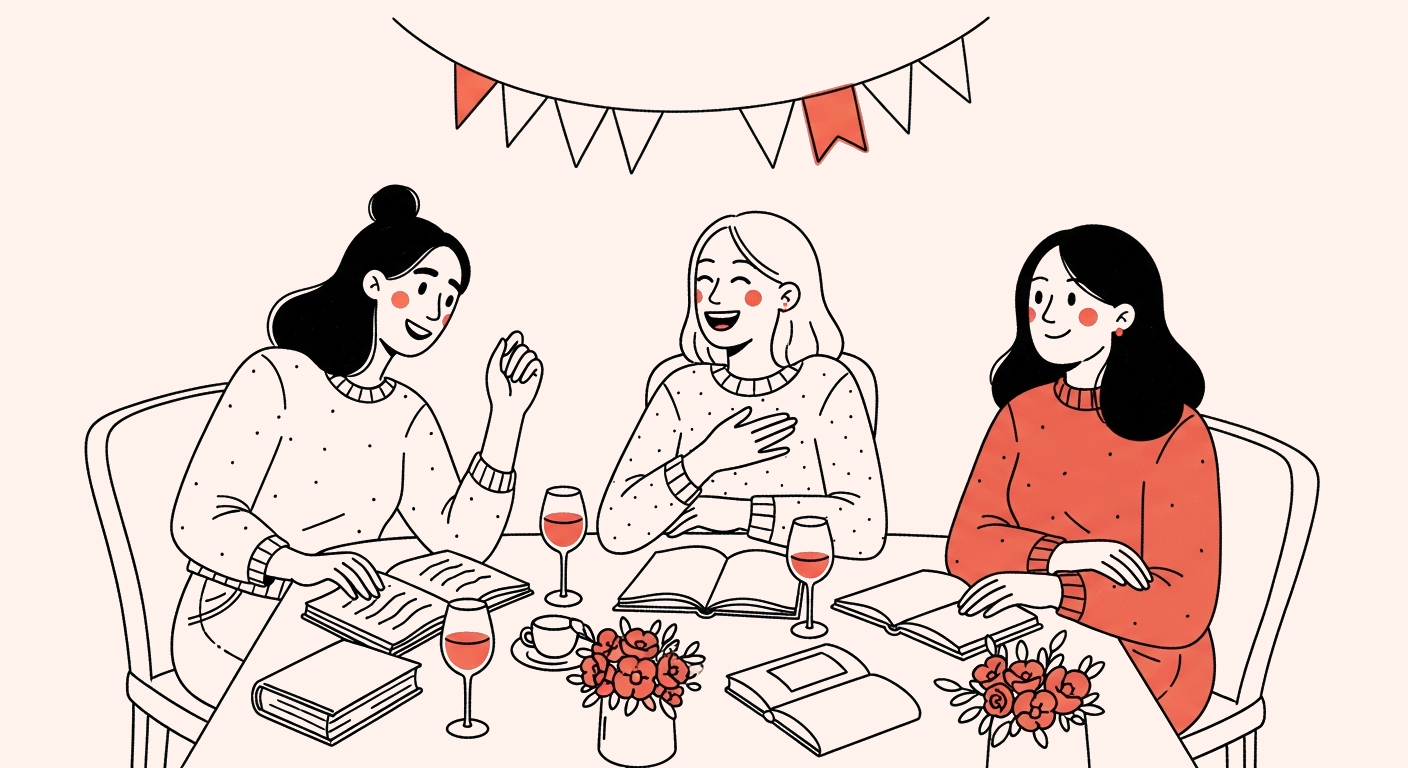
Mother's Day is six weeks out — which means you have exactly enough time to pick a book, read it, and host a meeting that wrecks everyone in the best possible way.
Some of the most honest book club conversations happen around stories that dig into family. The complicated love between mothers and daughters. The parents who stayed too long, or left too soon. The choices people make when there's no good option. These aren't always comfortable books to discuss. That's exactly why they work.
Here are 8 books that deliver real talk — paired with your book club group — before or after Mother's Day.
Two sisters in Nazi-occupied France. Vianne stays home, raises her daughter, and makes increasingly dangerous compromises to keep her family alive. Isabelle joins the Resistance and risks everything else. Both are impossible positions, and Kristin Hannah makes you feel every inch of that impossibility.
The mother-daughter thread runs through the entire novel — what a mother protects, what she hides, and what it costs her. Discussion questions practically generate themselves: Who made the right choices? What would you sacrifice? Where does courage end and recklessness begin?
This book usually leaves people quiet for a few minutes before the conversation starts. That silence is a sign you picked the right book.
Get the The Nightingale book club kit — discussion questions, icebreakers, food pairings, and themed decorations all included.
Kya Clark raises herself in the marshes of North Carolina after being abandoned — first by her mother, then by her siblings, then by everyone else. The novel is technically a mystery, but it's really a meditation on what happens to children left to figure out the world alone, and on the mothers who leave and the ones who never existed.
The abandoned mother is one of the most discussed threads in every book club that reads this. Why did she go? Could you have stayed? What does Kya's survival say about human resilience — or about the cost of having no one?
Get the Where the Crawdads Sing book club kit for a full set of discussion questions built around those exact threads.
Tara Westover grew up in rural Idaho without school, without medical care, and with a mother who believed her husband over her children. Educated is a memoir — which makes it hit differently than fiction. These things actually happened.
Westover's relationship with her mother is one of the book's most painful undercurrents. Her mother knows things she doesn't act on. She chooses her husband over her children in ways that are hard to read and harder to understand. And yet she's also more complicated than a villain.
The questions Educated raises — about loyalty, about belief, about what a mother owes her children — are exactly the kind of questions that make book clubs worth having.
Get the Educated book club kit — this one comes with context on survivalism, religious extremism, and the memoir genre that deepens the discussion.
Lily's relationship with her own mother — her complicated understanding of why her mother stayed, and what that taught her about what "love" looks like — is at the heart of this book. The plot runs through cycles of violence and forgiveness, and it's impossible to read without thinking about the women who shaped you.
Mother's Day season is the right time for this one. The conversations get intense. Have snacks and a plan for how to close on a note that isn't devastating.
Get the It Ends with Us book club kit — includes spoiler discussion questions, icebreakers, and a food and drink pairing guide.
Eleanor Oliphant is not fine. She's funny, and strange, and deeply broken in ways the novel reveals slowly and carefully. Her relationship with her mother — the voice in her head, the calls on Wednesdays, the things her mother did that the novel only shows you in pieces — is the wound at the center of everything.
This is the book that prompts the question: how much does a parent define a child? And is it possible to rebuild yourself from scratch, as an adult, using only your own hands?
The answer Eleanor Oliphant gives is both harder and more hopeful than you expect.
Get the Eleanor Oliphant Is Completely Fine book club kit.
Marianne's mother is present in the worst ways — cold, dismissive, the kind of parent whose damage you can only fully see from the outside. Connell's mother is warm, present, the parent Marianne never had. These family dynamics shape every interaction between the two leads, and Sally Rooney writes it so subtly you might not even notice how much of the book is actually about parents.
This is the book for groups who like to read closely and argue about what the text is actually doing. Rooney rewards the close reader.
Get the Normal People book club kit.
If none of the above fit your group's taste, these are worth considering — and you can search for them on Instant Book Club to get a full kit in 30 seconds.
Big Little Lies by Liane Moriarty. Three mothers at a school fundraiser. One of them is hiding something. A murder mystery wrapped around a brutally honest look at modern motherhood, parenting pressure, and the lies women tell each other to get through the week.
Little Fires Everywhere by Celeste Ng. Two very different mothers in a very controlled suburb of Cleveland. Mia Warren and Elena Richardson make every opposite choice from each other — and Ng makes both of them sympathetic and frustrating in equal measure. The question of who is the "good mother" is the whole argument of the book.
Pachinko by Min Jin Lee. A multigenerational saga spanning four generations of a Korean family. Sunja's choices as a young woman ripple through everyone who comes after her. This is the book if your group wants to go deep — it takes a full evening to do it justice — but it's one of the most rewarding discussions you'll have.
Mother's Day conversations in book club can go two ways: warm and celebratory, or deeply honest about complicated relationships. The best groups do both.
Start with an icebreaker before you open the book: What's one thing your mother — or someone who mothered you — taught you that you didn't appreciate until later? Give people a moment to think. Let the quieter members go first.
Then open the book discussion normally.
Close with this: What does the book say about what we owe each other across generations? That question works for every book on this list. It always leads somewhere real — and it lets people redirect toward their own experience without it feeling like therapy.
A few things to keep in mind:
- Some people have complicated feelings about Mother's Day. Acknowledge that before you start. A simple "this book goes to some heavy places — let's be kind to each other tonight" is enough.
- Set a rough time limit on the most painful sections so the discussion doesn't get stuck there. Move toward the ending.
- Leave room for people to sit with the ending. The best book club moments happen when you give people ten seconds of silence before asking the next question.
If you want discussion questions, icebreakers, themed food ideas, and printable decorations tailored to whatever book you pick, search for it on Instant Book Club and get a complete kit in 30 seconds. Every book on this list is in there.
Related reading: