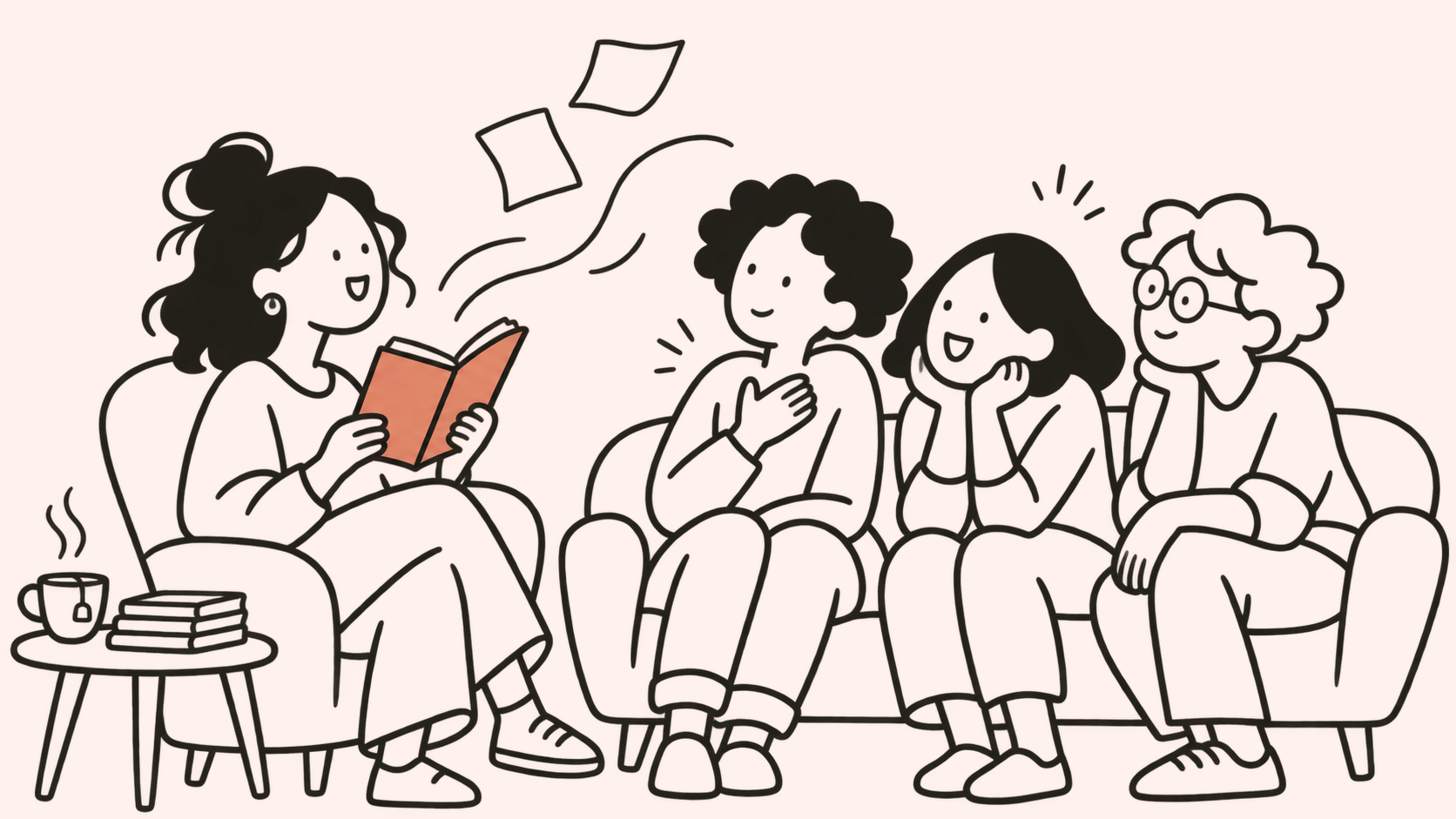
Every book club hits a month when nobody has time to read a 400-page novel. Somebody suggests a short story collection or a book of poems, and the room goes quiet in a very specific way. Half the group is relieved. The other half is quietly panicking because they haven't read a poem since high school.
A collection can make for one of your best meetings of the year. It can also fall flat in twenty minutes if you run it like a novel. The difference is mostly planning, and it's easy to get right.
A novel gives your group a shared plot to argue about. A collection gives you ten different stories, or sixty different poems, and no automatic way to start talking. That changes three things about how you plan.
There's no single thing to recap. In a novel, "what did you think of the ending?" works as an opener. In a collection, there are ten endings and half the group has forgotten the first story.
Everyone has a different favorite. That's a feature. It means disagreement shows up on its own, with no need to manufacture it.
The reading is lighter, but the thinking is not. A short story or a poem can take ten minutes to read and an hour to get to the bottom of. Tell your members that going in, so nobody walks in thinking this is the easy month.
If your group has been leaning on long novels lately, our guide to how to run a book club on a long book covers the opposite problem. A collection is a good palate cleanser after one.
The collection matters more than any discussion trick. A few rules help.
Choose a collection with a spine. Linked stories, a shared setting, or a clear theme gives your group something to compare across pieces. Olive Kitteridge by Elizabeth Strout follows one woman through a Maine town across linked stories, so it reads almost like a novel. Interpreter of Maladies by Jhumpa Lahiri circles immigration and distance, which gives people threads to pull on.
Keep the count manageable. Eight to twelve stories is plenty. A 300-page anthology with forty pieces will leave people reading the first five and skimming the rest.
For poetry, start with accessible, book-length work. Ada Limón's The Carrying and Ocean Vuong's Night Sky with Exit Wounds are widely read collections with a strong through-line, so they feel like one conversation rather than a pile of unrelated poems. Mary Oliver's Devotions is a gentle on-ramp for a group that says it doesn't read poetry.
Check the length against your meeting. A short book isn't automatically a short evening. If you want a quick-read pick for a busy month, our list of the best short books for book clubs has options, and the meeting length guide will help you set expectations.
The mistake most groups make is saying "read the whole thing" and then arriving to find that half the room read two stories. Be specific.
For short stories, try one of these:
- Read the whole collection. Works for groups of dedicated readers and collections under 200 pages.
- Read a required core. Pick four or five stories everyone reads, and let people read the rest as time allows. This is the sweet spot for most groups.
- Assign by member. Each person reads the whole book, then leads the conversation on one story they chose.
For poetry, the rule is different. Poems reward a second reading far more than a first, so ask members to read the book through once, then go back and mark three poems: one they loved, one they didn't understand, and one they'd read aloud. Those three picks become your agenda.
This is the biggest difference from a novel meeting, and the part that surprises people most. Poetry is written to be heard, and short stories land differently when you hear a paragraph in someone else's voice.
Open the meeting by having a member read one short piece, or a passage, aloud. For poetry, read a poem before anyone comments, then let a few seconds of silence pass. Those few seconds feel awkward and are exactly right. They give people time to form a real reaction rather than a polished one.
A simple flow for a 90-minute meeting looks like this:
- Settle in and read aloud (10 minutes). One member reads a story's opening page or a full poem.
- Round-robin favorites (20 minutes). Each person names their favorite piece and says why in two sentences. No arguing yet.
- Go deep on two or three pieces (40 minutes). Pick the ones with the most disagreement and dig in.
- Least favorite and the leftover (15 minutes). Ask which piece didn't work and why, then ask what's still bugging people.
- Wrap up (5 minutes). Pick the next book and announce the next date.
If you need a template, our book club meeting agenda breaks down how to time each segment, and it adapts easily to this format.
Generic questions like "what did you think?" produce "it was good." Be more specific. Try these for any short story:
- Why does the story start where it does? Short stories drop you in the middle. What would change if it started earlier?
- What does the title do? Titles in short fiction carry a lot of weight. Did you read it differently after you finished?
- Whose story is this, really? The narrator isn't always the person the story is about.
- What's left out? Short stories work by omission. What did you have to fill in yourself, and did everyone fill it in the same way?
- Where did it end, and did that feel right? Endings in short fiction are often open. This is where groups split.
If you collect good prompts over time, our guide to building a book club question bank shows how to keep them reusable.
Poetry intimidates people because they think there's a correct reading they're missing. Take that pressure off right away by saying so out loud: there's no answer key. Then use questions that point at what's on the page.
- Which line stuck with you, and why? Start with a line, not a theme.
- Where does the poem turn? Many poems shift direction partway through. Find the moment.
- What does the title add? Same question as stories, and it works just as well.
- What do the line breaks do? Read a passage as prose, then as written. What changed?
- Who is speaking, and who are they speaking to? The answer is often less obvious than it seems.
Ask members to point to specific words. It keeps the talk grounded and stops the evening from drifting into general opinions about whether poetry is "relatable."
Someone will say it, and it's a useful moment, not a problem. Don't explain the poem. Ask what they noticed. "I don't get it" almost always comes with an observation attached, like "the ending felt abrupt" or "I didn't know who was talking," and that's already a good question for the group.
Also remind everyone that confusion is allowed. Some of the best collection meetings come from admitting that a story baffled everyone and then working out why.
Short collections work best as part of a rotation, not a permanent switch. After a collection, go back to something with a strong narrative drive so people with a taste for plot don't drift away. You can also use novels that borrow the collection's strengths as a bridge:
- The Great Gatsby is short, dense, and packed with sentences worth reading aloud, so it suits groups who just enjoyed close reading.
- Circe by Madeline Miller is a novel in lyrical, almost poetic prose, ideal for a group that liked the sound of the poems.
- The Midnight Library moves through many short lives in quick succession, so it reads a lot like linked stories.
- Klara and the Sun uses spare, quiet language, and the small details carry the whole book.
If you want more picks in that mold, our literary fiction genre page collects titles with plenty to talk about.
Collections are a nice change of pace, but you still need discussion questions and a plan. Search for your book on Instant Book Club and get a complete kit in 30 seconds, including questions, icebreakers, and food pairings you can adapt to a short story or poetry night. If you're still choosing your next read, try searching by title and see what turns up.