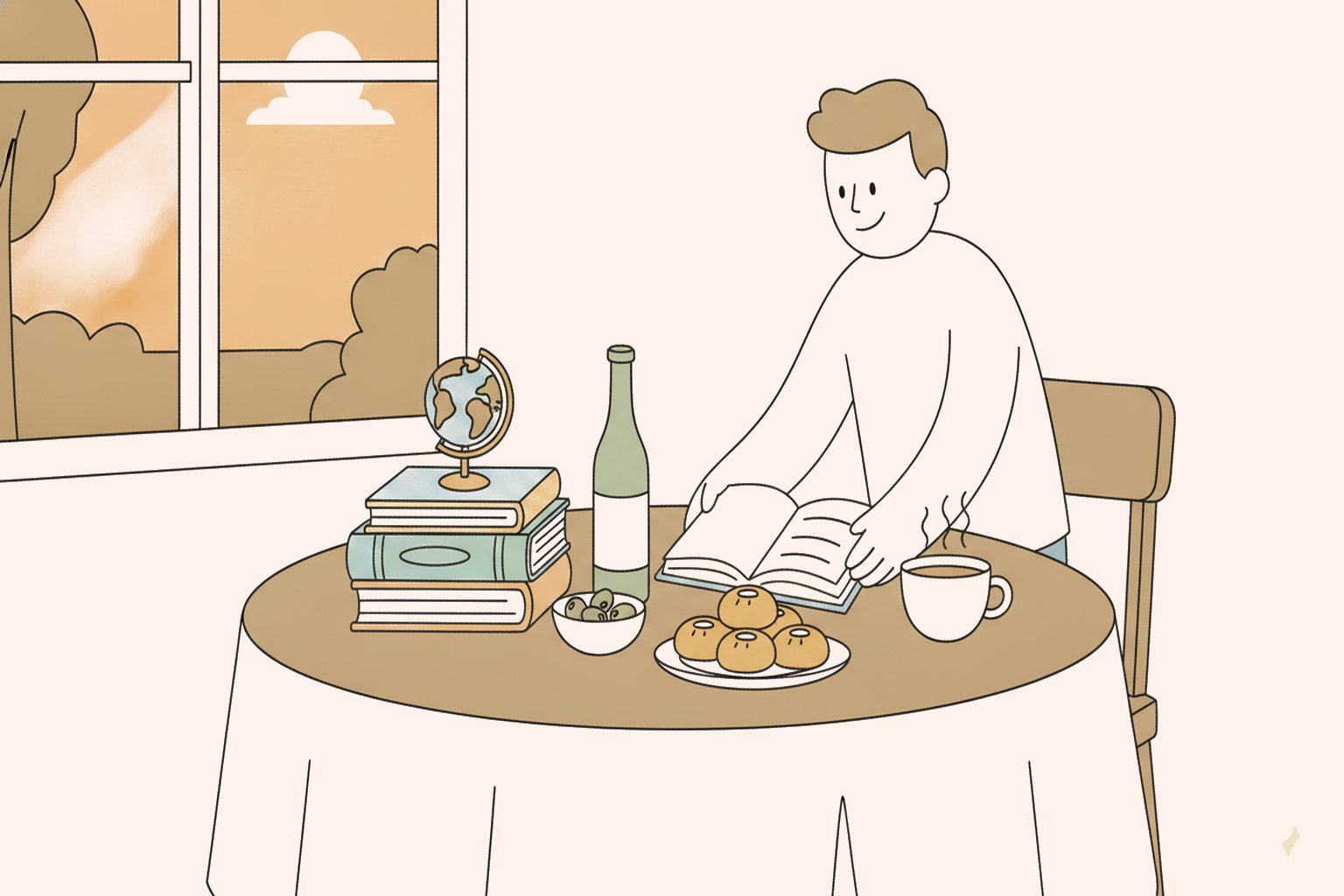
Themed food is the fastest way to make a book club feel like an event instead of a meeting. You don't need a multi-course dinner or a hand-lettered menu. One dish, one drink, and one small detail tied to the book is usually enough.
But a lot of hosts get stuck trying to be too clever. They want every course to map to a plot point. That way lies stress and a Pinterest board nobody asked for. The better approach is simpler: pick one anchor from the book — setting, era, or mood — and let the rest of the evening follow.
Here's how to match your menu to what you're reading without making it a second job.
Where a story takes place is the easiest entry point. It's concrete, your guests recognize it immediately, and it doesn't require them to have finished the book to appreciate the thought.
A novel set in coastal Maine means clam chowder, brown bread, and maybe a blueberry dessert. A book set in New Orleans invites gumbo, beignets, or a Sazerac. A story in contemporary Tokyo could be as simple as sake, edamame, and rice crackers.
The trick is to pick one or two recognizable touches rather than trying to recreate a regional cuisine. Your guests aren't expecting authenticity — they're expecting effort and a little fun.
If the setting is invented or ambiguous, look for what the characters eat and drink. Even a fantasy world usually gives you something to work with: spiced wine, honey cakes, flatbread, tea rituals. Use those details as your starting point.
Some books don't have a strong sense of place, but they do have a clear time period. Lean into that.
A 1960s novel calls for deviled eggs, cheese balls, and martinis. A 1970s pick means fondue or spinach dip in a bread bowl. Victorian fiction pairs naturally with tea sandwiches and scones. Prohibition-era stories are an excuse for mocktails served in coupe glasses.
The era route works especially well for historical fiction, literary novels, and memoirs. It also gives you a ready-made playlist and decoration scheme if you want to take the theme further.
Just keep the food approachable. A Jell-O mold might be period-accurate, but your guests don't need to eat it. Choose one or two era-appropriate items and let the rest of the spread be normal.
Some contemporary novels are deliberately placeless. In that case, match the emotional register of the book.
Dark and tense? Serve rich, heavy food — short ribs, chocolate torte, red wine. Light and romantic? Think strawberries, prosecco, small pastries. Cozy and autumnal? Soup, crusty bread, mulled cider. A book about grief or loss benefits from comfort food and zero performative plating.
Mood-matched menus work because they extend the reading experience. The food reinforces how the book made people feel, which makes the discussion more vivid.
You don't need six dishes. A good themed book club spread has three parts:
- One anchor dish or snack that clearly ties to the book.
- One drink that matches the setting, era, or mood.
- One easy detail — a playlist, a serving dish, a name card — that completes the atmosphere.
For example, if you're reading Circe by Madeline Miller, your anchor could be a Greek mezze board. The drink could be a white Greek wine or a honey-lemon cocktail. The detail could be candles in simple ceramic holders.
If you're reading The Seven Husbands of Evelyn Hugo, go Old Hollywood: a charcuterie board, champagne or Negronis, and a jazz playlist. That's it. The theme is obvious and the effort is minimal.
If you want food ideas tailored to a specific book, search for your book on Instant Book Club and generate a complete kit. Each kit includes discussion questions, icebreakers, food pairings, and printable decorations. It's the fastest way to turn a good book into a great night.
Some kits that work especially well with a setting-driven menu:
- Get the Circe book club kit — ancient Greece, mezze, honey, wine.
- Get the The Seven Husbands of Evelyn Hugo book club kit — Old Hollywood glamour and vintage cocktails.
- Get the The Nightingale book club kit — occupied France, simple wartime comfort food, wine.
- Get the The Kite Runner book club kit — Afghanistan, cardamom tea, dried fruit, nuts.
- Get the The Great Gatsby book club kit — Jazz Age Long Island, champagne, canapés.
Themed food isn't just atmosphere — it can be a discussion tool. Ask your group how a character's diet reflects their circumstances. Would the protagonist host this meal? What would they serve? What would be missing?
A single food detail can unlock a surprisingly deep conversation about class, culture, comfort, and power. And because people are eating while they talk, the discussion feels looser and more natural.
Not every book needs a themed menu. If a book is set in a dystopian wasteland, you don't have to serve canned goods. A good cheese board and a bottle of wine is always acceptable. The point of the theme is to add pleasure, not pressure.
If your group meets monthly, consider theming every other meeting rather than every single one. That keeps the special-occasion feeling alive without burning out the host.
If theming food becomes part of your group's culture, rotate who handles it. One person doesn't need to be the perpetual host. The person picking the book can also suggest a simple menu, or you can pair a "food lead" with a "discussion lead" for each meeting.
This keeps the workload light and gives different members a chance to bring their own style. For more on running a sustainable club, see how to organize a book club that lasts.
A themed menu is one of the cheapest ways to elevate a book club meeting. You don't need to be a great cook or a history expert. You just need one clear connection to the book and the willingness to follow it through.
Pick a setting, era, or mood. Choose one anchor dish and one drink. Add one small detail. Then let the book do the rest.
Related: Book Club Food Ideas: Themed Snacks for Every Meeting · How to Host a Themed Book Club · Book Club Decoration Ideas
Search for your book on Instant Book Club and get a complete meeting kit in 30 seconds — discussion questions, food pairings, icebreakers, and printable decorations.