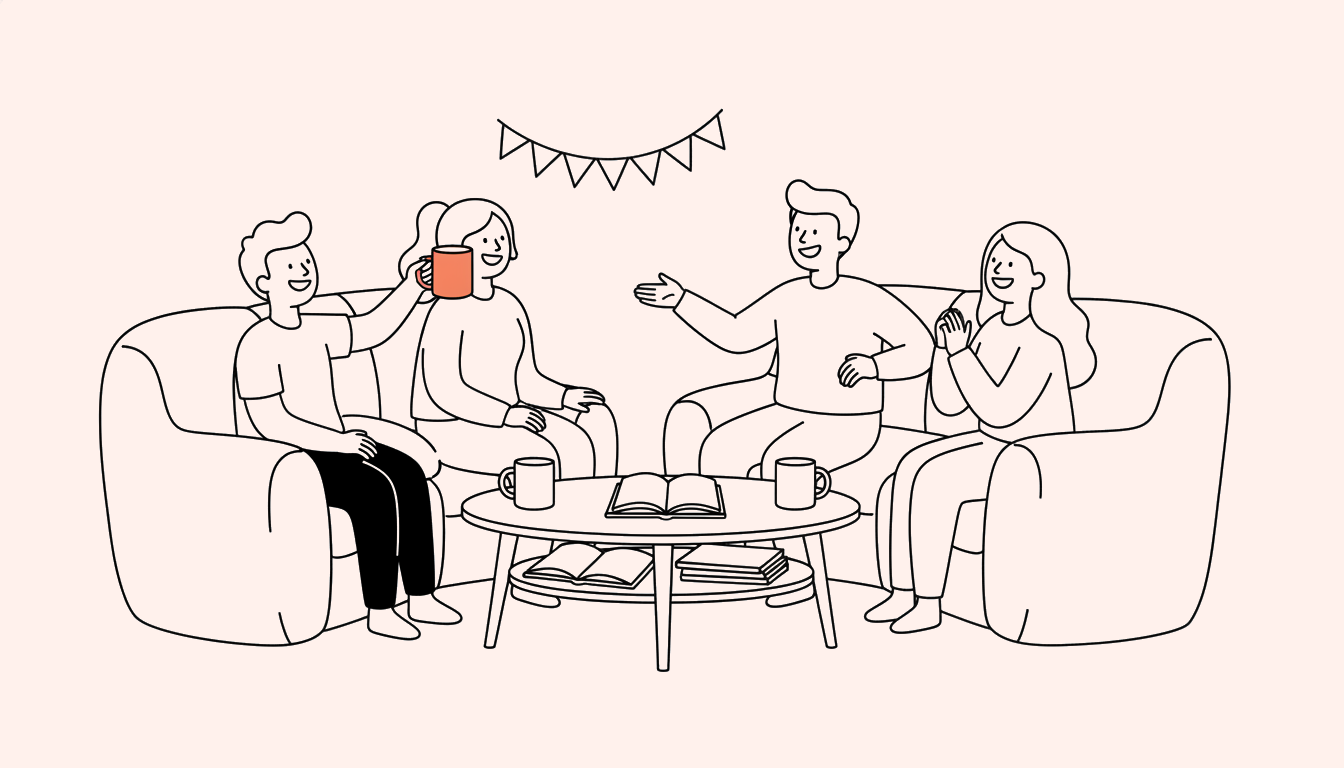
The difference between a book club that lasts and one that fizzles usually isn't the books. It's the traditions — the small, repeated moments that make members feel like they belong to something instead of just showing up for a meeting.
A tradition doesn't have to be elaborate. In fact, the best ones are simple enough to survive a busy month, a substitute host, or a member who forgot to read the book. What matters is that they happen again and again until they become "our thing."
Traditions do three jobs at once. They lower social friction, create shared memory, and give people a reason to come back even when the book wasn't their favorite.
When a new member walks into a room where everyone already knows the opener, the snack rotation, and the closing question, they relax faster. They don't have to figure out how to fit in — the structure shows them. For more on making first meetings feel natural, see the guide to hosting a book club meeting.
Shared memory is even more important. The inside jokes, recurring debates, and "remember when" moments are what bond a group over time. Books come and go; the group stays.
The easiest place to start is the meeting arc — the same structure every time, with one signature twist.
Pick a short ritual that kicks off discussion before anyone has to be profound. It could be a one-word review, a quick rating out of ten, or a "hot take, cold take" round where everyone shares their most and least popular opinion.
The goal isn't the answers — it's the predictability. People know what to expect, so they start talking sooner. There are dozens of icebreaker ideas if you want options that take under five minutes.
End every meeting with the same question. Something like:
- "What would you tell someone who hasn't read this book yet?"
- "Which character would you want at your real-life dinner party?"
- "One star or five stars — no explanation needed."
A closing question gives the meeting a clean landing. It also lets people who were quiet during the main discussion contribute one last thought.
Let one person close the night with a single sentence about the book. Rotate who gets the last word each month. It sounds small, but having a defined final voice keeps the conversation from trailing off awkwardly.
Food is the fastest way to make a meeting feel like an event. The trick is to keep it repeatable, not intimidating.
Whoever hosts picks one recipe tied to the book's setting, era, or mood. Reading The Nightingale? Bring French onion soup or a kir royale. Get the Nightingale book club kit for food pairings that match the story exactly. The tradition isn't fancy cooking — it's that someone always brings something worth talking about.
Every group should have one drink that shows up no matter what. Mulled wine in winter, lemonade in summer, a specific tea, or even just the same cheap red. Predictability is cozy. It signals that this is the same group, same vibe, different month.
Keep a running list of snacks that bombed. The member who once brought kale chips gets roasted forever. The group needs a few inside jokes, and this is a harmless one.
How you choose books can become a tradition too.
Each member gets to choose one book during their birthday month. It guarantees everyone gets at least one pick they truly love, and it spreads the responsibility across the year instead of dumping it on the organizer.
Set a loose schedule: fiction, nonfiction, thriller, romance, classic, wild card. It prevents the group from falling into a rut and gives people permission to suggest books they normally wouldn't. If your group wants a thriller month, Where the Crawdads Sing is a reliable choice with built-in atmosphere. Get the Where the Crawdads Sing book club kit.
Always have a next pick announced before the current meeting ends. No post-meeting group chat chaos, no three-week poll that ends in a tie. Just: "Next month we're reading Normal People." You can grab the Normal People kit the same night and send the invite with questions already attached.
Discussion habits can become rituals too — and they're often the most useful.
Before discussion starts, vote on who has to argue the least popular take. It turns disagreement into a game and keeps the conversation from becoming an echo chamber.
Some groups go spoiler-free until everyone finishes. Others don't care. Either is fine, but pick a safe word — "red light," "pause," "shield up" — anyone can say to stop a spoiler from slipping out. It removes the awkwardness of interrupting someone.
Give everyone exactly sixty seconds to complain about one thing in the book. Timed rants are funny, low-stakes, and weirdly therapeutic. They also surface the book's real weak spots faster than polite discussion does.
The group exists between meetings too. A few lightweight traditions keep momentum going.
A single group message two weeks before the meeting: "Who's reading? Who's struggling? Who's already finished and can't wait to talk?" No pressure, just a pulse check. It prevents the awkward silence where nobody admits they didn't finish.
Share one sentence from the book whenever something hits. It gives non-finishers a taste of the conversation and gives finishers a reason to revisit favorite passages.
Once a year, let the group vote on a book to read again. Re-reading builds loyalty — and the second discussion is almost always better than the first because people bring more context and less performance.
Don't make traditions chores. If the host has to bake a themed cake every month, people will stop hosting. Keep the effort low.
Don't introduce too many at once. Pick two or three and run them for a few months before adding more. Traditions only work when people remember them.
Don't force participation. The best rituals are opt-in by default. Someone should be able to skip the opener or pass on the rant without killing the mood.
You don't need a full system. Choose one opener, one food tradition, and one closing question. Run them at your next three meetings. If the group likes them, keep them. If they feel forced, swap them.
The point isn't perfection. The point is that your book club starts to feel like itself — a real group with its own habits, its own jokes, and its own reason to keep showing up.
If your group is starting to drift, the tips for keeping a book club going cover the structural side of long-term survival.
Search for your next book on Instant Book Club and get a complete kit with discussion questions, food pairings, icebreakers, and printable decorations — so your traditions have great material to build around.
More on building a stronger book club: