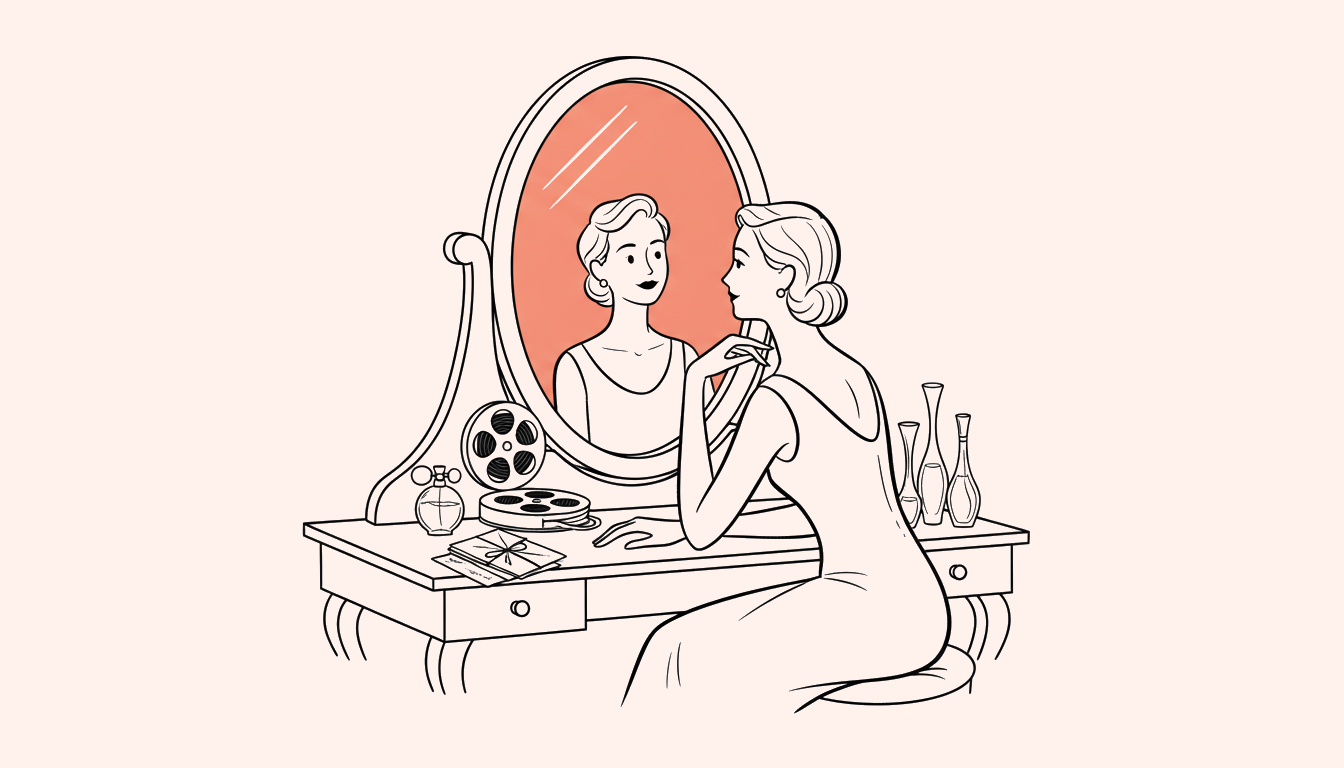
Taylor Jenkins Reid's The Seven Husbands of Evelyn Hugo is exactly the kind of book that makes book clubs run long. Nobody wants to leave. There's too much to say.
Evelyn is one of the most compelling antiheroes in recent fiction — brilliant, ruthless, deeply loving, and capable of real cruelty. Your group will not agree on her. That's a gift.
These questions go beyond plot recap and into the places where the book really lives: ambition, identity, desire, and the costs of a hidden life.
Before anything else, your group needs to sit with who Evelyn Hugo actually is — and who she was before she became Evelyn Hugo.
- Evita Gomez leaves Cuba as a teenager and erases herself to become Evelyn Hugo. What does that erasure cost her? What does it give her? Did you find her transformation triumphant, tragic, or both?
- Evelyn spends decades denying her Cuban heritage to survive in a white Hollywood. How does Reid portray the specific cruelty of that bargain — not just its practical logic, but what it does to Evelyn's sense of self?
- By the end of the novel, Evelyn has constructed a persona so convincing that even people who loved her saw mostly the performance. Do you think the real Evelyn — the one underneath — ever fully survived? Or did Evita Gomez disappear completely?
- Evelyn tells Monique that she did what she had to do. Is that a justification, an explanation, or an excuse? Does it matter which?
The marriages are the architecture of the book — and none of them are quite what they seem.
- Each husband serves a different function in Evelyn's life and career. Which marriage surprised you the most when you understood its actual purpose?
- Harry is the great tragedy — the one husband who might have been a real partnership. What do you make of their relationship? Was it love, mutual convenience, or something harder to name?
- Evelyn uses her marriages strategically in ways that were largely unavailable to men. Does Reid frame this as feminist resourcefulness, exploitation, or a damning indictment of the industry that made those strategies necessary?
- One of Evelyn's husbands is genuinely good, and she hurts him anyway. Who did your group see as the most innocent victim of Evelyn's ambition?
The heart of the novel is the love story that Evelyn couldn't tell the world. This is where the deepest discussions tend to happen.
- Celia is the love of Evelyn's life — but Evelyn also betrays her, repeatedly, in devastating ways. Does the depth of Evelyn's love for Celia make the betrayals more forgivable or less?
- Celia chooses to stay hidden partly because Evelyn makes that choice easy for her. How does power operate in their relationship? Who has more of it at different points in the story?
- The cost of their secrecy is enormous — years, health, time. If Evelyn had come out in the 1960s or 1970s, what do you think would have happened to her career? Would she have made the same choice?
- Reid gives Celia a complicated arc — she's not just a victim of Evelyn's choices. How did your group feel about Celia by the end?
The Seven Husbands of Evelyn Hugo is fundamentally a book about what it costs to want things.
- Evelyn achieves everything she set out to achieve. Is she a success? What does your group's answer reveal about how you define success?
- The novel suggests that Evelyn's greatest performances weren't on screen — they were in interviews, at parties, in marriages. What does it say about Hollywood, about fame, or about women specifically that her survival required constant performance?
- Several characters sacrifice themselves — or are sacrificed — for Evelyn's ambition. Does Evelyn ever fully reckon with what she's taken from other people?
- If Evelyn had been born fifty years later, do you think she would have made different choices? Or is there something essential about Evelyn that would have found different but equally complicated paths?
Monique is easy to overlook in the Evelyn-dazzle, but her role is load-bearing.
- Reid chooses to filter Evelyn's story through Monique — a journalist with her own secrets and her own reasons for being chosen. How does that frame affect how you trust the story you're reading?
- The reason Evelyn chose Monique specifically is one of the novel's best reveals. Did you see it coming? How did the reveal reframe your reading of Monique's narration?
- Monique enters the story as a professional observer and ends it as someone personally implicated. Did you find her transformation convincing? Did you like her?
- Evelyn is telling her story the way she wants it told. How much of it do you believe? What might she be shaping, omitting, or reframing for her own purposes?
The novel asks hard questions about what we leave behind and who gets to decide.
- Evelyn dies before the biography is published. She never has to see how the world responds. Is that a gift she gives herself, or an avoidance?
- The book suggests that a person's public legacy and their private reality can be almost entirely separate. Who in your own life — celebrity, historical figure, or otherwise — has made you think about this gap?
- Evelyn carefully controls her story right up to the end. Is that integrity or manipulation?
- If Celia had lived, do you think Evelyn would have told the truth publicly — or kept the secret forever?
If your book club includes anyone who thinks about craft, these go deeper into how Reid built the thing.
- Reid uses a novel-within-an-interview structure. How does the layered narration change the reading experience compared to a straightforward first-person voice?
- The book spans roughly fifty years. How does Reid create the sense of a whole life passing without the narrative feeling rushed?
- Evelyn is a morally complex character who the reader ultimately loves despite her worst moments. What does Reid do technically to make that happen? Where did you tip from judgment to sympathy?
- The seven-husband structure is a formal device. Did it feel like a gimmick to you, or did the organization earn itself?
End with the big ones — the questions that don't have right answers.
- On a scale of 1–10, how do you rate The Seven Husbands of Evelyn Hugo? Go around the room before discussing.
- Does Evelyn deserve forgiveness?
- Is this primarily a love story, a Hollywood story, or a story about survival? Can it be all three?
- What's the one moment in the book that you can't stop thinking about?
The Seven Husbands of Evelyn Hugo tends to create devoted Taylor Jenkins Reid readers. Daisy Jones & The Six is the obvious next pick — another story told through a retrospective interview format, another iconic woman, another hidden truth at the center of it all.
If your group loved the portrait of a woman navigating an industry stacked against her, Lessons in Chemistry has similar energy — different era, equally sharp. Or reach for The Vanishing Half if your group wants to keep exploring themes of identity, race, and the lives we construct to survive.
For something more recent with that same "I need to talk about what just happened" energy, Where the Crawdads Sing and Little Fires Everywhere both deliver.
Grab the Seven Husbands of Evelyn Hugo book club kit for discussion questions at three spoiler levels, themed food and drink pairings (we went with golden-era Hollywood cocktails and a cheese spread worthy of a studio party), icebreakers, and printable decorations.
Or search for any book on Instant Book Club and get a complete kit in 30 seconds — questions, food, vibe, decorations, the works. You bring the wine; let us handle the rest.
More from the blog: How to Host a Book Club Meeting · 25 Best Book Club Books for 2026 · How to Start a Book Club