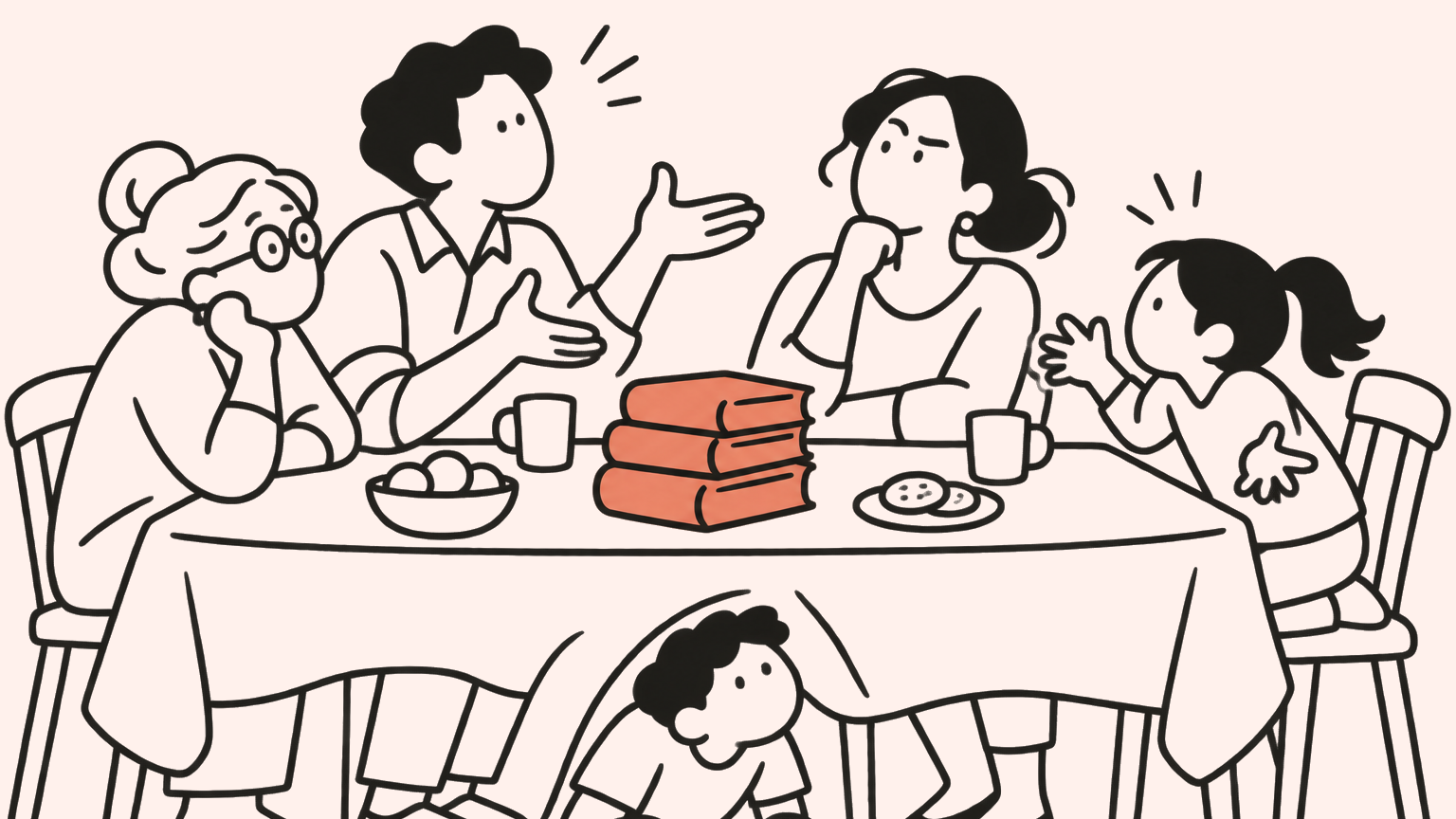
Thanksgiving is less than two weeks away, and a lot of your members are about to spend a few days with the people who know exactly which buttons to push. That makes this a surprisingly good time to read about families that are far more complicated than theirs.
Books about complicated families make some of the best book club picks. Everybody has a family, so everybody has something to say, but the characters take the heat off. Your members can talk about loyalty, secrets, and old grudges without confessing a single thing about their own table.
Here are five books that do it well, what each one gets a group talking about, and how to host the conversation so it stays warm.
A good family book gives your group a shared language for things people usually keep private. Nobody has to say "my father and I don't talk." They can say "Baba reminded me of someone," and the room understands.
These books also split a group in useful ways. People disagree about who was right, who was cruel, and who deserves forgiveness, and they disagree based on where they sit in their own families. The eldest daughter and the youngest son read the same chapter and come away with different verdicts.
That is the whole point of a book club discussion. You are not looking for agreement. You are looking for the moment somebody says "wait, you saw it that way?"
Tara Westover grew up in rural Idaho in a survivalist family. She did not go to school until she was seventeen, and she eventually made it to Cambridge. The memoir is about education, but the real subject is what it costs to leave the family that raised you.
This is the strongest pick on the list for a group that likes to argue. Members split on how much responsibility the parents carry, whether love and harm can coexist, and what Westover owed her family once she saw the world differently. Because it is a memoir about real people, read our memoir discussion guide first. Get the Educated book club kit, or start with our Educated questions.
Pachinko follows one Korean family across four generations, from a fishing village in the early 1900s to Japan in the 1980s. The family is not dramatic in the loud way. The drama comes from sacrifice, from decisions made quietly for the sake of the next generation, and from the cost those decisions carry.
It works well for groups because every reader attaches to a different family member. Some people take Sunja's side all the way through, while others spend the meeting defending her sons. It is long, so give your group extra time and check our guide to running a book club on a long book. Pull up the Pachinko kit, or read our Pachinko questions for the main debates.
The Kite Runner is about two boys in Kabul, a wealthy father who is hard to please, and a betrayal that Amir spends the rest of his life trying to answer for. At its core, it is about a son who badly wants his father's approval and the damage that wanting does.
Fathers and sons come up in this meeting more than you might expect, and so does guilt. Groups tend to divide over whether Amir earns redemption, which is a big argument and a good one. The book includes violence and difficult scenes, so send a quick heads-up with the pick. See the Kite Runner kit, or browse more from Khaled Hosseini.
The family at the center of The Nightingale is two sisters in occupied France who were never close, with a father who left them with more questions than answers. The war puts them in opposite situations, and each makes choices the other would never make.
This is the most sisterly pick on the list, and a good one if your group includes siblings or has strong feelings about birth order. It also gives people something to be moved by together, which helps when the other picks are heavier. Our Nightingale questions post covers the biggest debates, and the kit sorts questions by spoiler level. Fans can find more on the Kristin Hannah page.
Kya is abandoned by her mother, then by her siblings, and finally by her father, until she is a young girl alone in a North Carolina marsh. The book is a mystery and a coming-of-age story, but what lingers is the way each family member leaves, and how a child makes sense of being left.
It is the easiest read here, so it suits a group that wants something with a plot to follow. The family conversation is still there: what a parent owes a child, and how loneliness gets passed along. Grab the Crawdads kit, or look at our Crawdads questions. More from this author lives on the Delia Owens page.
The book is half the job. The other half is keeping the conversation on the page when it wants to drift toward last Christmas. A few things that help:
- Start with the characters, not the members. Ask "Why does Baba act this way?" before you ask "Does your family do this?" Let people come into the personal conversation on their own.
- Say out loud that nobody has to share. One sentence at the start, such as "bring your own stories if you want to, or stay with the book," takes the pressure off and usually makes people more willing to talk.
- Give opposing views room. If half the group sides with a parent and half with the child, don't resolve it. Ask each side what the other is missing.
- Protect the quiet members. Some people read these books because their own families are hard. Don't call on anyone, and let silence sit.
- End on something light. Finish with a toast, a snack, or a vote on the next pick so nobody leaves heavy.
For more on this, read our guide to handling sensitive topics in book club. It covers what to do when a conversation turns personal faster than you planned.
If you need to choose fast:
- Your group loves a good argument: Educated
- Your group has time and likes big, sweeping stories: Pachinko
- Your group wants a book that hits hard: The Kite Runner
- Your group has sisters in it: The Nightingale
- Your group wants a page-turner: Where the Crawdads Sing
You can also pair a family pick with a lighter meeting. If you are already planning something social for the season, our Friendsgiving book club ideas and book club holiday party ideas give you easy options. If you want a different tone, browse our November book club picks or explore more literary fiction and memoir and nonfiction titles.
Choosing the book is the easy part. Writing questions about family that go beyond "did you relate?" takes time, and it is the part most hosts skip.
Search for your book on Instant Book Club and get a complete kit in 30 seconds, with discussion questions sorted by spoiler level, food and drink pairings, and printable extras. It works for every book on this list, and any other book your group wants to bring to the table.
Then pour something warm, and let the fictional families take the heat off the real ones. If the grief and loneliness threads came up in your discussion, our lists of books about grief and loss and books about loneliness and connection are good places to go next.